
Aluminum Profile Bending
Heavy Thick-Wall Bending - Crack Control and Heat Treatment
Forming 8-12 mm walls without cracks: coarse grain and orange peel, edge preparation, forming soft then aging, warm forming, dye penetrant checks.
Detalles del producto
A thick-wall bend that cracks usually cracks for one of two reasons, and they are not the same problem. Either the strain at your radius exceeds what the temper can take, or the material at the bend has a coarse grain structure that fails before its handbook elongation says it should. The first is a geometry problem; the second is a metallurgy problem, and the second is the one that surprises people.
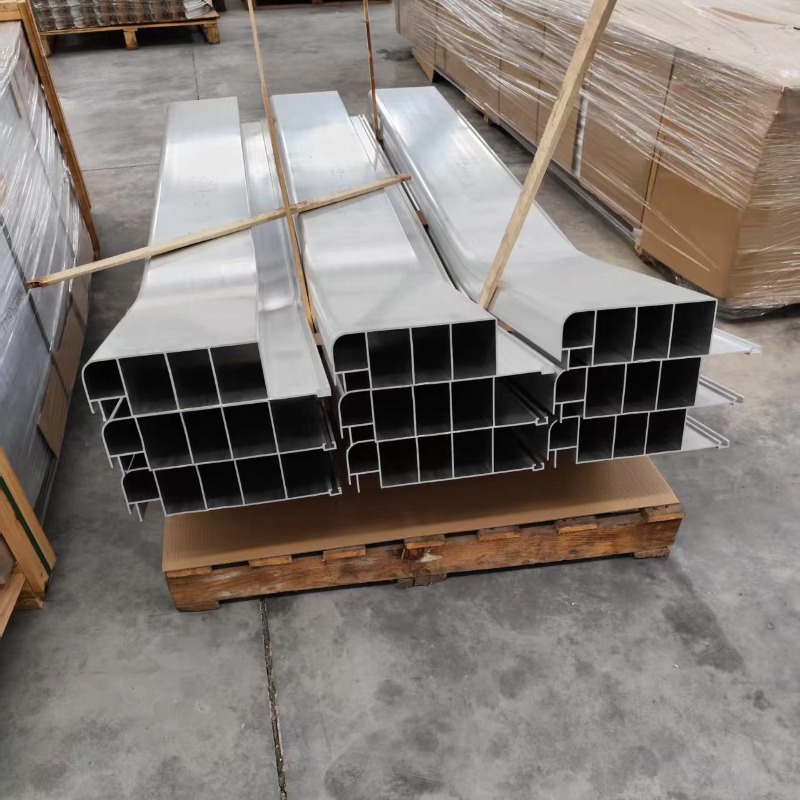
We form 8–12 mm walls in 6061-T6 and 6082-T6 into heavy right-angle bends, thick U-channels and load-bearing Z-frames, with an angular tolerance of ±1° in lengths up to 6,500 mm. This page is about preventing and detecting cracks, and about the process routes available when a radius is tighter than the temper will allow.
Coarse grain: why a thick wall can fail early
Handbooks give 6061-T6 an elongation at break of around 10–12 percent. That figure comes from a tensile specimen, usually cut from a small section, and it assumes a fine, uniform grain structure. A thick-wall extrusion does not always have one.
Recall the extrusion ratio: a heavy section runs at a much lower ratio than a small profile — sometimes below 10. Low deformation means the cast structure of the billet is broken up less, and the recrystallised grain stays coarse. On the outside of a bend, a coarse grain produces two effects:
- Lower ductility in practice than the handbook figure. The grain boundaries are fewer and the strain concentrates at them.
- Orange peel. Individual grains deform visibly, producing a rough, dimpled surface on the outside of the bend before any crack appears. Orange peel is a warning sign, not a cosmetic issue.
So if a heavy section shows orange peel at the bend, the material is telling you it is at its limit even if the calculation said it had margin. The two responses are to increase the radius, or to change the material state — see the process routes below.
A related point: two sections of the same alloy and temper can behave differently in bending if they came from different extrusion ratios. That is why a bend that works on a 60 mm thick section may crack on a 200 mm one at the same radius and wall. The radius calculation is necessary but not sufficient.
Where the crack starts
On a heavy bend, the crack almost always starts in one of three places, and knowing which one tells you what to change.
| Ubicación | Por qué | Fix |
|---|---|---|
| Outer corner of the bend | Maximum tensile strain; often a sharp die radius concentrates it further | Larger corner radius, larger bend radius, or a softer temper |
| Cut edge on the outer fibre | A burr or a sheared edge is a stress raiser sitting in the highest-strain region | Deburr and radius the edge before bending |
| Inner corner, as a fold | Compression side buckles into a fold, which then tears the outer side as the geometry collapses | Support, or a larger radius |
The second row is the most avoidable and the most common. A saw-cut edge has a burr of a few tenths of a millimetre, and at the strain levels of a heavy T6 bend that burr is enough to start a crack that then runs across the section. Deburring before forming costs almost nothing and prevents a whole class of failures.
Process routes when the radius is too tight for T6
When the strain calculation says the radius is beyond the temper, there are three routes. All of them work; all of them have a cost that has to be understood before choosing.
Route 1 — bend in a softer temper, then age. The section is formed in T4 or in an annealed condition, where ductility is high and the radius is comfortable, and then artificially aged to recover strength. The catch is the aging cycle: it involves a quench, and quenching a formed part distorts it. The distortion has to be corrected, and correcting a formed part is a second forming operation on material that is now harder.
Route 2 — warm forming. Heating the bend zone to around 150–200 °C reduces the flow stress and raises the achievable strain. It is a real effect and it enables radii that would crack cold. The cost is overaging: at those temperatures the alloy loses 5–15 percent of its yield strength, permanently, in the heated zone. On a load-bearing part that has to be in the design calculation.
Route 3 — local induction heating. For a very tight radius on a heavy section, the bend zone is heated locally and formed hot, with the rest of the part staying cold and keeping its temper. This is the most capable route and the most expensive: it needs a dedicated coil, a controlled heating and cooling cycle, and a much slower operation.
| Ruta | Radius capability | Strength effect | When it is the right answer |
|---|---|---|---|
| Cold form in T6 | R ≥ 5× wall | None | The default when the calculation allows it |
| Form in T4 or O, then age | R ≥ 2.5–3× wall | Full T6 recovered, but distortion | A tight radius on a part that needs full strength |
| Warm forming at 150–200 °C | R ≥ 3–4× wall | 5–15% yield loss in the heated zone | Moderate radius with no heat-treat facility for route 2 |
| Local induction heating | R < 3× wall | Loss limited to the heated band | A very tight radius where the rest of the part must stay T6 |
Crack detection: what to look for and when
A heavy bend can carry a crack that is not visible in normal light. The check has to be deliberate:
Visual, at the right angle and with the right light. A crack on the outer corner of a heavy bend is often a hairline that only shows under raking light. Check before anodising, because anodising wicks into a crack and makes it visible — too late to scrap the part economically.
Dye penetrant on critical parts. For a load-bearing member, a penetrant test on the bend zone is the reliable check. It is a shop-floor test, it takes minutes, and it finds the cracks a visual check misses.
Surface texture as an indicator. Orange peel on the outer fibre means the material is at its forming limit. Even without a crack, that is a warning that the margin is gone and the next batch may fail.
Wall thickness after forming. The outer wall thins as it stretches. Measure it at the point of maximum bend, and compare with the minimum your design allows. A part can pass a visual check and have lost 15 percent of its wall in the highest-stress region.
Especificaciones
| Elemento | Valor de referencia |
|---|---|
| Espesor de pared | 8–12 mm, heavier by arrangement |
| Formas | Thick right-angle, heavy U-channel, load-bearing Z-frame |
| Tolerancia angular | ±1° with springback compensation |
| Minimum radius, cold in T6 | ≥5× wall |
| Minimum radius, formed soft then aged | ≥2.5–3× wall |
| Longitud máxima | 6,500 mm |
| Aleaciones | 6061-T6, 6082-T6 |
| Crack inspection | Visual under raking light; dye penetrant on request |
| Equipo | Large-tonnage CNC bending machines, CNC machining centres |
| Aguas abajo | Fresado, taladrado, roscado, corte y soldadura CNC |
| Tratamiento superficial | Anodizado, anodizado duro, recubrimiento en polvo |
| Estándar | GB/T 6892-2023, ISO 9001 |
Dónde no encaja
- The calculated strain exceeds the material's forming limit and the part must stay T6. The only routes are warm forming with a documented strength loss, induction heating, or a redesign. There is no fourth option where the part keeps full T6 at a radius the temper cannot take.
- The section shows orange peel at the first trial. The material is at its limit. Increase the radius or change the material state; do not run the batch and hope.
- The outer wall thins below your design minimum. A thicker starting section may be required, which changes weight and cost. Raise it at quotation.
- The part must be dye-penetrant tested to an acceptance standard you have not specified. Tell us the standard at enquiry. It changes the process flow — penetrant has to be done before anodising, and it adds a step.
- The part will be welded at or near the bend. The heat-affected zone of the weld and the strained zone of the bend overlap, and both are weaker than parent metal. Move the weld or thicken the region.
- You need a sharp outer corner on a heavy bend. A sharp corner concentrates strain. A small radius at the corner is the difference between forming and cracking.
Qué enviar para una cotización
Send the section drawing with the wall thickness, the bend drawing with the inside radius and the corner radii, the alloy and temper, the load the part carries, the length and the quantity. Tell us whether the part must retain full T6 and whether the bend zone is a critical inspection area.
We will reply with the outer fibre strain at your radius, whether it is inside the forming limit for the actual section — not just the handbook — the process route we recommend if it is not, the strength consequence of that route, and the inspection we would perform. If the only routes involve a strength loss you cannot accept, that goes in the reply rather than in a failed lot.
Preguntas frecuentes
What radius can you achieve on an 8–12 mm wall?
Reference 5 times the wall cold in T6, which is about R40 for an 8 mm wall and R60 for a 12 mm wall. Tighter radii are possible by forming in a softer temper and aging afterwards, or by warm forming, at the cost described above. These are capability references: the value on your order is set by your drawing, and we calculate the achievable radius for your actual section before quoting.
Why does a heavy bend crack when the calculation says it should not?
Usually coarse grain. A heavy section has a low extrusion ratio, which means a coarser grain structure than a small profile, and a coarser grain delivers less real ductility than the handbook elongation figure. The symptom is orange peel on the outer fibre before the crack appears.
Can I bend 6061-T6 to a tight radius without losing strength?
No. If the strain at your radius exceeds what T6 can take, the only routes that work involve either a strength loss in the bend zone (warm forming), a heat treatment after forming (form soft, then age, with distortion to correct), or local heating that limits the loss to a band. A supplier who says otherwise is either not calculating or not telling you.
What is orange peel?
A rough, dimpled surface on the outside of a bend, caused by individual coarse grains deforming visibly. It indicates the material is at or near its forming limit. It is not purely cosmetic: it is a warning that a crack may follow, and on a visible part it is also a finishing problem.
How do you check for cracks?
Visual inspection under raking light before anodising, dye penetrant testing for load-bearing parts, and a wall thickness measurement at the point of maximum bend. Anodising should not be the first time a crack becomes visible — by then the part has been through the finishing line.
Does the wall get thinner at the bend?
Yes, on the outer fibre, typically 5–15 percent depending on the radius relative to the wall. On a heavy load-bearing part that thinning is a strength reduction in the highest-stress region, so it should be measured against a design minimum rather than assumed acceptable.
¿Cómo se cotiza?
On the wall thickness, the radius, the length and the quantity, with the process route made explicit. A cold T6 bend, a form-soft-then-age bend and an induction-heated bend are three different jobs with three different costs, and they are quoted as such rather than averaged.
Envíe su plano
Email the section drawing, the bend geometry with the inside and corner radii, the alloy, the load case and whether the bend is a critical inspection area to linjunbing@truetrustlv.com, or send it on WhatsApp at +86 136 6644 0600. You will get a strain assessment, a process route with its strength consequence, and a written tolerance statement.
OBTENER UNA COTIZACIÓN
Una vez que haya enviado sus requisitos, nos pondremos en contacto con usted lo antes posible con respecto a su consulta de producto.:Heavy Thick-Wall Bending - Crack Control and Heat Treatment