
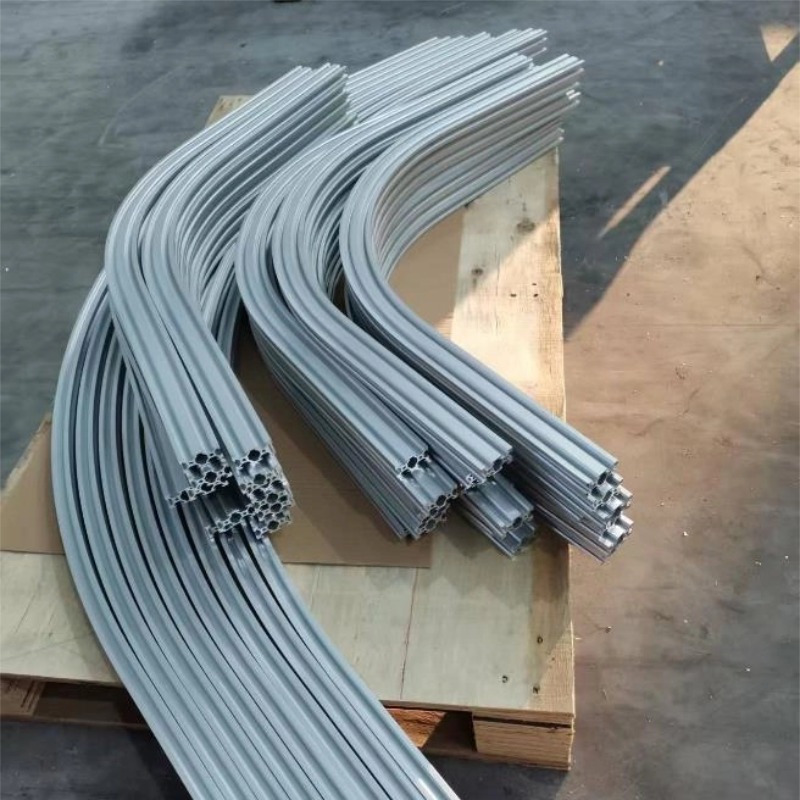
Aluminum Profile Bending
Doblado extralargo de una pieza - 6.500 mm sin empalmes
Doblado hasta 6.500 mm en una pasada: sin soldadura en la zona de máxima tensión, deriva de curvatura en 6,5 m y flecha por peso propio al medir.
Detalles del producto
When a curved member is longer than the machine, the obvious answer is to make it in two pieces and join them. That answer is usually wrong, and not for cosmetic reasons. A joint in the middle of a curve puts a weld in the highest-stress region of the part, on a surface that then has to be dressed back to a profile — and dressing a weld on a curve removes wall thickness unevenly.
We form profiles up to 6,500 mm in a single pass, in L, U, Z, right-angle, obtuse and acute forms, with walls from 1 to 6 mm and an angular tolerance of ±1°, in 6063-T5 and 6061-T6. This page is about what one-piece forming actually buys, and where the limits are.
Three real reasons to avoid the joint
The weld sits where the stress is highest. On a curved member carrying load, the maximum bending stress is at the outer fibre of the curve. A joint near mid-span is at or close to that point. The heat-affected zone is 50–65 percent of parent strength, so the joint is both the highest-stress location and the weakest material.
Dressing the weld removes wall thickness. A weld on a flat surface can be ground flush without changing the section. A weld on a curve has to be dressed to a profile, and getting it right means removing material from the parent metal as well as the weld. The result is a local thin spot, in the same place as the highest stress.
The error accumulates at the joint. Segmented bending means each segment has its own angle and radius error, and the joint has to absorb the mismatch. On a long curve that shows as a kink or a step. On a running surface it is an impact point.
For a decorative part, the joint is a visible line. For a structural part, it is a weak point. For a running surface, it is a defect. None of these are fixed by welding better.
Curvature drift over 6.5 metres
On a long part, the risk is not the accuracy of any one point — it is the consistency along the length. A curvature that drifts steadily produces a part where every local measurement is acceptable and the ends are in the wrong place.
Do the arithmetic. If the curvature is 0.1° per metre off, and the error accumulates in the same direction, by the end of 6.5 m the accumulated angle is 0.65°. The lateral displacement at the end of the part is then roughly a third of the length times that angle — tens of millimetres on a 6.5 m member.
That is why a long one-piece part needs a different inspection from a short one. Checking the radius at three points does not detect a drift. The check that works is the relationship between the ends: the chord length between them, the end tangents, and the maximum deviation from the intended curve measured along the whole length.
So a specification for a 6.5 m curved member needs three numbers, and most drawings only give one:
| Requisito | What it controls | Typically stated? |
|---|---|---|
| Local radius or curvature | The shape at any point | Sí |
| End-to-end chord or angle | The accumulated error | Raramente |
| Maximum deviation from the true curve along the length | Drift and local flattening | Raramente |
The third is the one that matters for a part that has to be visually smooth or mechanically true. It is also the one that can be measured with a template or a total station, so it is not difficult to specify — it is just usually forgotten.
Self-weight: the part sags before you measure it
A 6.5 m aluminium profile is not rigid. Supported only at its ends, it sags under its own weight, and the sag depends on the section — a light open profile may drop several millimetres at mid-span.
Two consequences:
Measure it the way it will be installed. If the member is supported at six points in service, support it at six points when checking. Measuring it on two trestles and comparing to a drawing made for the installed condition will produce a disagreement that has nothing to do with the forming.
Handle it with support along the length. Lifting a long curved part at two points puts a reverse bend into it, and a thin-wall part will take a permanent set. Long parts need a spreader or a multi-point sling.
The same applies to packing and shipping. A 6.5 m curved part shipped flat on a pallet, supported at two points, arrives with a different curve than it left with. If the part is a visible architectural member, the packing is part of the specification.
Especificaciones
| Elemento | Valor de referencia |
|---|---|
| Formas de doblado | L, U, Z, right-angle, obtuse, acute |
| Dimensión formada mínima | 10 mm |
| Espesor de pared | 1–6 mm |
| Maximum length, one piece | 6,500 mm |
| Tolerancia angular | ±1° |
| Aleaciones | 6063-T5, 6061-T6 |
| Equipo | Extra-long CNC press brake, CNC machining centre |
| Aguas abajo | Fresado, taladrado, roscado, corte y soldadura CNC |
| Tratamiento superficial | Anodising, hard anodising, powder coating, brushing |
| Estándar | GB/T 6892-2023, ISO 9001 |
One-piece against segmented
| Segmented and spliced | One-piece forming | |
|---|---|---|
| Method | Formed in pieces, welded or joined | Formed in a single pass |
| Appearance | Visible weld and splice marks | No splice marks |
| Resistencia | Reduced at the joint, in the HAZ | Uniform along the length |
| Cumulative error | Accumulates per segment | Single forming; error is one setup |
| Equipo | Standard press brake | Extra-long CNC press brake |
| Limits | Length-limited by transport | Machine and transport length both matter |
The trade is straightforward. If the length is available in one piece and the part is visible or structural, one-piece is better on every measure except transport. If the part has to travel in a container, or the length exceeds what can be shipped, segmentation is forced — and then the joint should be designed for the load, not just for the length.
The all-important joint, when you cannot avoid it
Sometimes segmentation is unavoidable. Then the joint has to be designed deliberately:
- Put it where the moment is low. Near a support, not at mid-span. On a curved member, near the end of the curve rather than at the crown.
- Make it a sleeve or a splice plate, not a butt weld. A sleeve carries load through the joint instead of relying on the weld across the full section.
- Machine the joint faces. Two formed ends butted together inherit both angle errors. Machined faces at the joint remove that.
- Keep it off the visible face. If the joint must be visible, design it as a feature — a collar or a band — rather than trying to hide a weld.
Dónde no encaja
- The part is longer than 6,500 mm. It cannot be formed in one piece on this equipment. Segment it and design the joint properly.
- The part has to ship in a standard container. Transport length, not machine length, is the limit. Plan the joint to fall on a natural division.
- The section is thin-wall and the length is at the maximum. Handling and self-weight dominate; the part may be correct on the machine and bowed at the far end. Specify the support and the packing.
- The part is a running surface and cannot take a joint. Then the length has to be within one-piece capability, or the track has to be redesigned so the joint falls where the carriage never runs.
- You need a tolerance tighter than ±1° at both ends of a long part. Accumulated error will exceed it. Machine the end features after forming, from a datum on the formed part.
- Only one piece is needed and the section is custom. A long die and a one-off setup are disproportionate. Consider segmentation with a designed joint.
Qué enviar para una cotización
Send the section drawing, the formed-part drawing with the curve and the end conditions, the alloy and temper, the quantity, the total length, and the interface positions at each end. Tell us how the part will be supported in service — that sets the measurement condition and the packing requirement.
We will reply with the one-piece feasibility at your length, the achievable curvature consistency, how the ends are controlled, the handling and packing we recommend, and the tolerance we can confirm. If the part should be segmented, we will say so and propose a joint position and design.
Preguntas frecuentes
What length and accuracy can you achieve in one piece?
Reference 6,500 mm in a single pass, with ±1° on the bend angle. Those are capability references: the value on your order is set by your drawing, and on a long part we also need the end-to-end requirement, because local angle accuracy does not define where the ends finish up. We confirm the local and the cumulative tolerance in writing before you order.
Why is one-piece bending better than splicing?
Three reasons. There is no weld in the highest-stress region of a curved member. There is no dressing operation that thins the wall locally. And there is no accumulated error absorbed at a joint. The visual benefit — no splice mark — is real but it is the least important of the three.
Can the precision of a long one-piece bend be guaranteed?
To ±1° per bend and to an agreed cumulative figure, yes. What cannot be guaranteed is a tight tolerance on a flexible part measured under an undefined condition: a 6.5 m profile sags under its own weight, so the measurement has to match the support condition. Agree both the tolerance and the method.
What limits the maximum length?
The machine bed and the ability to handle the part, and separately the transport length. A part that can be formed may still not be shippable in one piece. If the length is close to the limit, tell us early — the answer may be a design change rather than a process change.
¿Cómo se cotiza?
On the profile length, the wall thickness and the bend type. A long part needs a long bed, more handling and more support, and the setup per part is larger. It is priced per part rather than per metre, because the difficulty does not scale linearly with length.
Can a long part be welded after forming?
Yes, with the usual caveat: welding adds shrinkage, and on a long part the shrinkage accumulates. If the assembly has welds, the bent member may need to be pre-set to allow for the closing that welding causes. Tell us at enquiry.
¿Cuál es el lote mínimo y el plazo?
Reference minimum 50 kg, small batches supported. A long one-piece part requires the full bed, so it occupies the machine for a longer window; lead time reflects that rather than a fixed number of days.
Envíe su plano
Email the section drawing, the curve, the length and the end interfaces to linjunbing@truetrustlv.com, or send it on WhatsApp at +86 136 6644 0600. You will get a one-piece feasibility answer, a curvature consistency statement and a joint proposal if segmentation is needed.
OBTENER UNA COTIZACIÓN
Una vez que haya enviado sus requisitos, nos pondremos en contacto con usted lo antes posible con respecto a su consulta de producto.:Doblado extralargo de una pieza - 6.500 mm sin empalmes