Aluminum Profile Bending
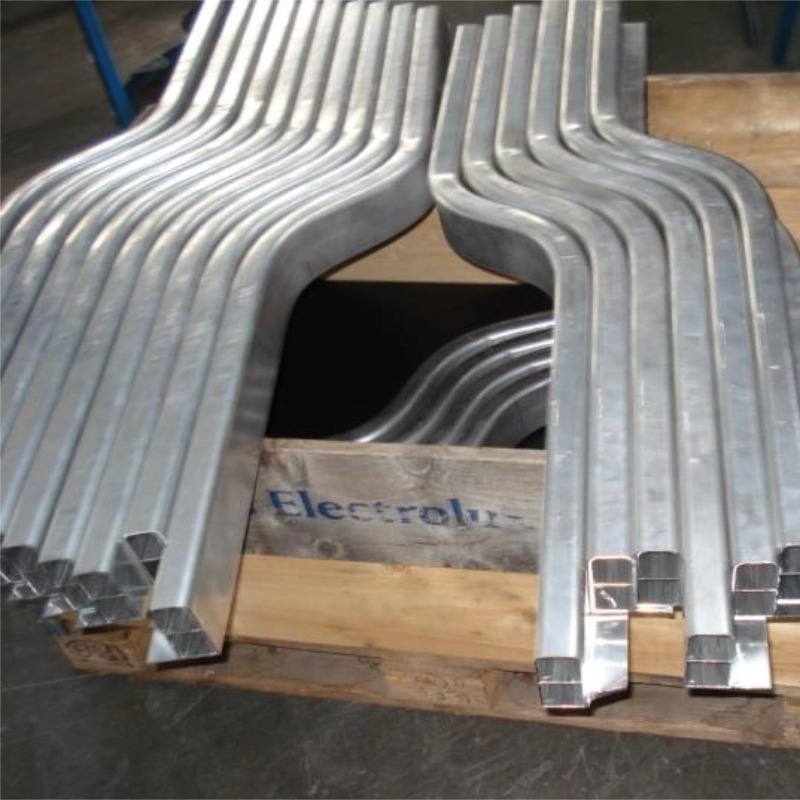
Doblado por estiramiento multicurvatura - Perfiles en S, W y elípticos
Doblado en S, W, U, elíptico y parabólico con compensación de recuperación elástica por segmento: curvatura continua, control de inflexión, ±0,4 mm.
Detalles del producto
A single arc is one radius, one springback value, one compensation. A multi-curvature part is a sequence of different radii joined together, so every segment springs back by a different amount, and the compensation that makes one segment correct makes its neighbour wrong.
We stretch bend multi-curvature profiles — S, W, U, elliptical, parabolic and arc-with-straight combinations — in 6063-T5, 6061-T6 and 6082-T6, to a reference radius error of ±0.4 mm. Here is what changes when the curve stops being a circle.
Why each segment needs its own compensation
Springback depends on the ratio of elastic to plastic strain at the bend, which depends on the radius relative to the wall and on the section stiffness. On a multi-curvature part, those ratios change from segment to segment.
Consider a part that runs from R200 to R800. At R200 the material is bent hard, most of the section is plastic, and the springback is small. At R800 the bend is gentle, a larger part of the section stays elastic, and the springback is proportionally larger. If the same compensation is applied to both, the tight segment is right and the gentle one is open — or the other way round.
So the tool has to apply a varying over-bend along the part. On a CNC stretch bender this is a programmed curve, not a die shape. On a manual machine it is a sequence of settings, which is why multi-curvature work is slower and less repeatable on older equipment.
| Segment type | Relative springback | Compensation approach |
|---|---|---|
| Tight radius at the start of the part | Bajo | Small over-bend; the material is fully plastic |
| Large radius in the middle | Alto | Larger over-bend; much of the section stays elastic |
| Inflection between two arcs | Varies rapidly | Transition zone; the compensation must be continuous here |
| Straight section between arcs | Zero | No over-bend; the transition to the arc is the critical point |
The inflection point is where it fails
Where a curve changes direction — an S-bend, or a W with a reverse in the middle — the curvature passes through zero. At that point, the material is not being bent in either direction, and the transition from one curvature to the other has to be smooth or the part shows a kink.
A kink at an inflection is not a dimensional error in the usual sense: the radius on either side can be exactly right, and the part still reads as a crease at the middle. On a decorative part it is a visual defect; on a guide rail it is an impact point for a wheel; on a structural member it is a stress concentration.
The controls are in the forming program and in the die. A continuous CNC path avoids the discontinuity because the curvature is a smooth function of position. A segmented manual path produces a discontinuity unless a transition segment is deliberately formed between the two arcs — a short arc at an intermediate radius that bridges them.
This is why a drawing that defines an S-bend as "R300 one way then R300 the other way, meeting at the midpoint" is under-specified. There is no transition, and the join is the weak point. A better definition gives the tangent direction at the inflection, or specifies a transition radius.
True curves versus segmented approximation
An ellipse or a parabola is a curve of continuously varying radius. Two ways to make it:
True variable-curvature forming. A CNC stretch bender follows a programmed curvature profile, producing a genuinely continuous curve. This is the right method for an ellipse or a parabola where the shape is functional — an aerodynamic fairing, an optical support, a forming tool.
Segmented approximation. The curve is divided into a number of constant-radius arcs joined at points close enough that the eye does not see the joins. It works for architectural and decorative parts where a 3–5 mm deviation from the true curve is acceptable.
The choice is set by the drawing's tolerance. If the drawing gives a true ellipse with a profile tolerance of ±0.5 mm, segmentation will not meet it unless the segments are short. If the drawing gives three radii and two tangent points, segmentation is exactly what was asked for.
Especificaciones
| Elemento | Valor de referencia |
|---|---|
| Formas | S, W, U, elliptical, parabolic, arc with straight sections |
| Error de radio | ±0.4 mm |
| Compensación | Segmented, per curvature |
| Aleaciones | 6063-T5, 6061-T6, 6082-T6 |
| Secciones | Tubo redondo, tubo cuadrado, canal, angular, perfil especial |
| Longitud máxima | up to 20 m, subject to the curve |
| Equipo | High-precision CNC stretch bending machines |
| Soporte interno | Diseño de matriz, extrusión, mecanizado CNC, soldadura |
| Tratamiento superficial | Anodizado, anodizado duro, recubrimiento en polvo |
| Estándar | GB/T 6892-2023, ISO 9001 |
Multi-curvature against single-curvature
| Single-curvature | Multi-curvature | |
|---|---|---|
| Shape | One standard arc | S, W, U, ellipse, parabola, compound |
| Curvature count | One | Several, formed continuously |
| Compensación | One setting | Segmented, varying along the part |
| Equipo | Standard stretch bender | High-precision CNC stretch bender |
| Dominant defect | Error de radio | Kink at the inflection; local radius drift |
| Definition needed | Radius and arc length | Curvature profile, or tangent points between segments |
The last row is where most multi-curvature projects lose time. A drawing that gives the end points and the maximum deviation does not define the curve; several different curves satisfy it, and the machine will produce one of them. Send the curvature profile, or the tangent directions at the segment boundaries, and the part will be what you designed.
Alloy choice
6063-T5 for formability: it holds a multi-curvature shape with less springback variation across the segments, and the surface quality is the best of the three. Most architectural and conveyor work is in this alloy.
6061-T6 where the part carries load. The springback variation across segments is larger, because the material has less ductility and the elastic range is proportionally wider, so the compensation curve is more sensitive to batch variation.
6082-T6 for loaded parts with better toughness, and it is a reasonable compromise where the curve is complex and the load is real.
One thing worth saying: a multi-curvature part in T6 is more sensitive to batch-to-batch variation than a single arc, because there are more segments where a small springback change can show. If the part is at the tolerance limit, plan for a trial piece from each lot.
Dónde no encaja
- The inflection is required to be sharp. A sharp reverse is a kink by definition. If the design needs it, it is a bend or a joint, not a formed curve.
- The curve is a true ellipse with a tight profile tolerance and the equipment is not available. Segmentation will not meet it unless the segments are very short, which makes the part expensive.
- The section is asymmetric and the curve reverses. The twist from the asymmetry changes sign at the inflection, and the part corkscrews. Symmetrise the section.
- The part has to be anodised and the visible face is on the outside of a tight segment. Forming marks show most where the bend is hardest.
- The quantity is small and the curve is complex. Programming a variable-curvature path plus a trial piece is a real setup. For a few pieces, a segmented fabrication may be cheaper.
- The drawing does not define the curve. Without a curvature profile or tangent definition, the acceptance criteria are ambiguous and the first article will be a negotiation. Close that before ordering.
Qué enviar para una cotización
Send the section drawing, the curve definition — radii, arc lengths, tangent points, or a CAD profile — the alloy and temper, the quantity, and the tolerance on the profile. If the curve is functional rather than decorative, tell us what it does: an aerodynamic surface, a guide path and an architectural screen all have different acceptance criteria even at the same tolerance.
We will reply with the forming method, the compensation approach, the segment boundaries we would use if segmenting, and the tolerance we can confirm. If the curve cannot be formed in one piece at the required tolerance, we will say so and propose a segmentation with the joints in defined positions.
Preguntas frecuentes
What radius tolerance can you hold on a multi-curvature part?
Reference ±0.4 mm on the radius of each segment, with the curve defined by a profile tolerance. Those are capability references: the value on your order is set by your drawing, and on a multi-curvature part we also need the inflection definition, because the radius can be right on both sides and the joint between them can still be a kink. We confirm both in writing before you order.
How is multi-curvature different from single-curvature stretch bending?
Compensation. A single arc has one springback value, so one over-bend setting. A multi-curvature part has a different springback in every segment, so the over-bend has to vary along the length, which means a programmed path rather than a fixed die setting. It also introduces the inflection point as a new failure mode.
Can you form a true ellipse or parabola?
Yes, on CNC equipment following a programmed curvature profile. The alternative is segmenting the curve into constant-radius arcs, which is fine for a decorative part and not fine for a functional surface with a tight profile tolerance. Tell us which you need.
Why does my S-bend have a crease in the middle?
Because the curvature goes through zero at the inflection and the transition was not formed smoothly. Two arcs meeting at a point produce a kink. The fix is either a continuous programmed path or a deliberate transition segment of intermediate radius between the two arcs.
¿Qué aleación debo elegir?
6063-T5 for formability and surface, which is most of the work in this class. 6061-T6 where the part carries load, accepting greater springback variation and more sensitivity to batch. 6082-T6 as a middle option for loaded parts with a complex curve.
¿Se puede soldar después del conformado?
Yes, with the usual caution: welding a formed part adds shrinkage that changes the curve. If the assembly needs welds near the curved sections, tell us at enquiry — the bend may need to be pre-set open to allow for the weld closing it.
¿Cómo se cotiza?
On the curve complexity, the number of segments, the section and the quantity. A variable-curvature program plus a trial piece is the setup; the forming itself is slower than a single arc because the machine is following a path rather than a setting. The price follows the work, not a per-metre rate.
Envíe su plano
Email the section drawing, the curve profile and the tolerance, the alloy and the quantity to linjunbing@truetrustlv.com, or send it on WhatsApp at +86 136 6644 0600. You will get a forming method, a segmentation proposal if needed, and a written tolerance statement.
OBTENER UNA COTIZACIÓN
Una vez que haya enviado sus requisitos, nos pondremos en contacto con usted lo antes posible con respecto a su consulta de producto.:Doblado por estiramiento multicurvatura - Perfiles en S, W y elípticos