
Industrial aluminum profiles
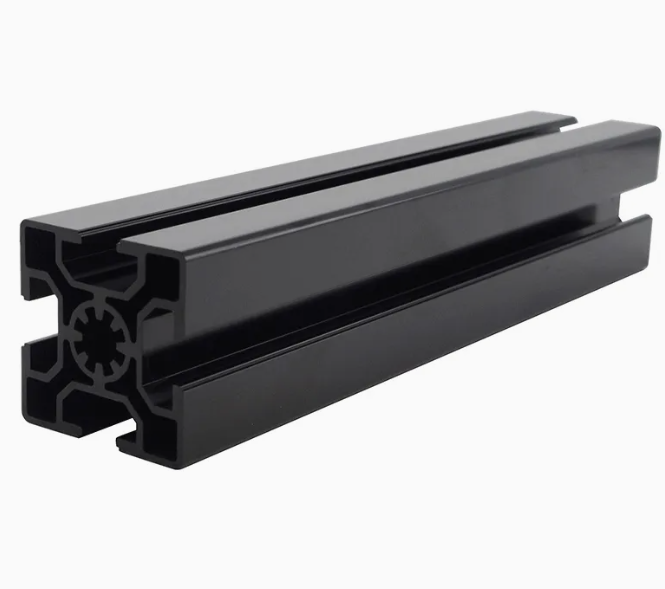
Perfil de aluminio con ranura en T 10-5050 - 50 x 50 mm, ranura de 10 mm
Perfil 10-5050: 50x50 mm, ranura de 10 mm, 6063-T5, pared de 3,5 mm, 3,50 kg/m, I 22,00 cm4. Elegido por la ranura de 10 mm, no por rigidez.
Detalles del producto
Respuesta breve: 10-5050 is a 50 × 50 mm square in the 10-series: 10 mm slot, 6063-T5, 3.5 mm wall, 3.50 kg/m, moment of inertia 22.00 cm⁴. At the same 50 mm size the 8-series version is 17.80 cm⁴ at 2.20 kg/m, so this profile is only 24 percent stiffer but 59 percent heavier. It is not a stiffness upgrade. It is chosen for the 10 mm slot: heavier bolts, stronger brackets, and more wall to tap. Section and tolerance are set by your drawing.
Para qué se utiliza
It goes into frames that are part of the 10-series system and need a compact column or a short beam: machine sub-frames, heavy fixture bases, robot tooling structures, mounting frames for bought-in equipment with a heavy bolt pattern, and brackets that have to take a large fastener.
The pattern is the same as 8-4040B in the 8-series, one size up. When a joint has to carry a heavy load through a small number of bolts, or when a thread has to live in the profile rather than in an insert, wall thickness and slot width matter more than moment of inertia.
It is also used where the design is already 10-series and a smaller member is needed than 10-9090A, since the fittings then stay consistent across the whole frame.
Especificaciones
| Elemento | 8-5050 | 10-5050 |
|---|---|---|
| Sección | 50 × 50 mm | 50 × 50 mm |
| Ancho de ranura | 8 mm | 10 mm |
| Espesor de pared | 2.5 mm | 3.5 mm |
| Peso | 2.20 kg/m | 3.50 kg/m (+59%) |
| Momento de inercia | 17.80 cm⁴ | 22.00 cm⁴ (+24%) |
| Deflection, 1 m, 10 kg | About 0.16 mm | About 0.13 mm |
| Rigidez por kg | About 8.1 | About 6.3 |
| Best reason to choose | Stiffness in 50 mm | Slot width and wall for connections |
Why the numbers look wrong
Side by side, the 10-5050 is 24 percent stiffer and 59 percent heavier than the 8-5050. Its stiffness per kilogram drops from about 8.1 to 6.3, which makes it the least efficient 50 mm option on a pure stiffness basis. Anyone comparing the two on inertia alone would conclude the 10-series version is a bad deal.
They would be right, and they would also be missing the point. The 10-5050 is not sold as a stiffer 5050. It is sold as a 50 mm member with a 10 mm slot and a 3.5 mm wall, which is a different specification aimed at a different problem. The moment of inertia is a consequence of the wall, not the reason for it.
If stiffness in a 50 mm envelope is the actual requirement, the answer is 8-5050, and if more stiffness is needed, 8-6060 at 36.00 cm⁴ and 3.20 kg/m beats the 10-5050 on both counts. So a customer who buys 10-5050 for stiffness has paid 59 percent more weight for less stiffness than a 6060. That is the mis-selection this page exists to prevent.
Dónde encaja esto
It fits when the frame is 10-series, when the joint needs a 10 mm slot and heavier hardware, and when a thread has to be cut into the profile itself.
Dónde no encaja: if the requirement is stiffness, use 8-5050 or 8-6060 and get more for less weight. If the frame is 8-series, introducing one 10-series member means a second hardware family. And if the load needs a real structural section, 10-9090A is the size that acts as a column rather than a member.
What the 3.5 mm wall actually buys
A thread with substance. In a 3.5 mm wall a tapped hole has enough material to carry a load and to be re-cut once if it is damaged. In a 2.5 mm wall the thread is thinner and less forgiving. On a fixture plate that is drilled and re-drilled, that difference decides whether the part survives a season.
A 10 mm slot with real brackets. The heavier slot takes a larger bracket and a bigger bolt, which increases the friction area and the preload a joint can carry. On a joint that has to resist a moment, that matters more than the section's inertia, because a joint that slips makes the section irrelevant.
Resistance to local deformation under a bolt. A thick wall does not dish when a large bolt is tightened, so the preload stays where it was set. On a vibrating machine a dished joint looks like a loose bolt and is often re-tightened repeatedly without being fixed.
And a better ratio between the slot and the remaining face. A 10 mm slot on a 50 mm face leaves more material either side than an 8 mm slot on the same face, which gives the bracket more bearing area. That is the detail that makes a 50 mm 10-series member feel more solid than a 50 mm 8-series one, even though it is not much stiffer.
None of this is about deflection. The 0.16 to 0.13 mm change at 1 m with 10 kg is not visible and will not change a design decision. If your calculation is marginal at 0.16 mm, it is still marginal at 0.13, and the answer is a larger section rather than a heavier wall.
Qué enviar para una cotización
- The drawing with the joint details and the bolt sizes
- Whether the frame is otherwise 10-series
- Which positions need a thread in the profile
- Any span requirement, so the section can be checked for that separately
Preguntas frecuentes
¿Qué tolerancia puede mantener?
Cut length and machined features are held to the tolerance on your drawing, including hole position within a pattern. The value on your order is set by your drawing. Where a pattern is dense, we check the remaining wall between holes before machining, since the thicker wall is the reason this profile was chosen and it should not be wasted by a poor layout.
Is 10-5050 stiffer than 8-5050?
By about 24 percent, from 17.80 to 22.00 cm⁴, for 59 percent more weight. So it is stiffer but less efficient. It is not the right choice if stiffness is the only criterion.
What is it actually for?
The 10 mm slot and the 3.5 mm wall. It takes heavier bolts, bigger brackets and a thread in the profile, which suits a joint that carries a large load through a small number of fasteners. That is a connection requirement, not a stiffness one.
If I need stiffness in 50 mm, what should I use?
8-5050 gives 17.80 cm⁴ at 2.20 kg/m, and 8-6060 gives 36.00 cm⁴ at 3.20 kg/m. The 6060 is the better buy for stiffness, being lighter and much stiffer than 10-5050.
Can I mix it with 8-series members?
Mechanically with adapters, but the slot and the fittings differ, so a mixed frame needs two hardware sets. On a project it is usually better to choose one series for the whole frame.
What finish is usual?
Clear or black anodizing. On a fixture plate the finish also protects the slot faces from the repeated handling that the part was chosen to survive.
Siguiente paso
Send the drawing with the joint details and the bolt sizes. We will cut and machine to your drawing and tell you if a member needs a larger section rather than a heavier wall.
Correo: linjunbing@truetrustlv.com | Llame o WhatsApp: +86 136 6644 0600
OBTENER UNA COTIZACIÓN
Una vez que haya enviado sus requisitos, nos pondremos en contacto con usted lo antes posible con respecto a su consulta de producto.:Perfil de aluminio con ranura en T 10-5050 - 50 x 50 mm, ranura de 10 mm