
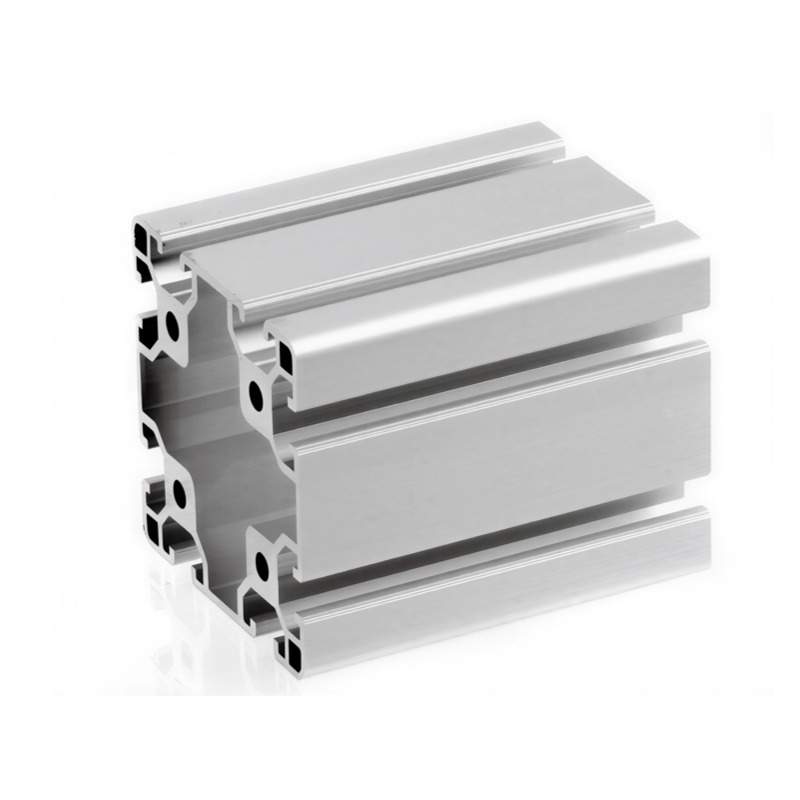
Industrial aluminum profiles
8-6060 T-Slot Aluminum Profile - 60 x 60 mm, 8 mm Slot
8-6060 profile: 60x60 mm, 8 mm slot, 6063-T5, 3.0 mm wall, 3.20 kg/m, I 36.00 cm4 both ways. Smallest square usable as a column. Per drawing.
Detalles del producto
Respuesta breve: 8-6060 is a 60 × 60 mm square in the 8-series: 8 mm slot, 6063-T5, 3.0 mm wall, 3.20 kg/m, moment of inertia 36.00 cm⁴. It is the smallest square in the range that can stand on its own as a column, and 4.23 times stiffer than 8-4040. Its distinguishing property is that it is isotropic: it can take fittings on all four faces and it does not care which way the load comes. Section and tolerance are set by your drawing.
Para qué se utiliza
It carries the main structure of a machine: uprights, gantry columns, robot cell posts, heavy enclosure corners, press frames, and the legs of equipment that has to stand on four points with bracing in both directions.
The case it is made for is the column that has to do two jobs at once. It must resist a load from one direction and also carry brackets, guards, sensors or cable trays on faces that point in other directions. A rectangle is more efficient for the first job and awkward for the second, because material is concentrated in one plane and the fitting faces are either narrow or badly oriented.
A 60 mm square solves both. The section is stiff enough to act as a column, and all four faces take 8-series fittings, so the design does not have to choose between structure and attachment.
Especificaciones
| Elemento | Valor | Nota |
|---|---|---|
| Sección | 60 × 60 mm square | Serie 8, ranura de 8 mm |
| Aleación y temple | 6063-T5 | Estándar para el rango |
| Espesor de pared | 3.0 mm | |
| Peso | 3.20 kg/m | 2.2 times 8-4040 |
| Momento de inercia | 36.00 cm⁴ | Equal both directions, 4.23 times 8-4040 |
| Ancho de ranura | 8 mm, on all four faces | 8-series fittings |
| Deflection, 1 m, 10 kg at centre | About 0.08 mm | Peso propio excluido |
| Rigidez por kg | About 11.3 cm⁴ per kg/m | Against 5.9 for 8-4040 |
Why the square wins for a column
A column is loaded from whatever direction the machine pushes it. That may be the cutting force, a moving axis, a belt pull, a safety impact, or simply the offset weight of a component. A rectangle has a weak axis, and if the load does not happen to align with the strong axis, the weak one governs. At 8-3060 that penalty is a factor of 3.8. A square removes the question entirely, which on a machine that may be reconfigured is worth more than the last few percent of efficiency.
Fittings on all four faces is a design freedom, not a convenience. A gantry column usually has to carry a guard on one face, a cable tray on another, a sensor bracket on a third, and a brace on the fourth. On a rectangle at least two of those faces are too narrow for a proper bracket. On a 60 mm square every face is a mounting surface, so the design does not accumulate adapters.
The step from 4040 is large enough to be a real change. At 36.00 against 8.52 cm⁴, the stiffness is 4.23 times, which takes a 1 m deflection from about 0.34 mm to about 0.08 mm. This is the point in the range where a frame stops behaving like a frame and starts behaving like a machine structure: the deflection becomes small enough that other things, such as the joints and the base, become the governing elements.
And it is the smallest size that can stand alone. The 5050 and the 4040 are frame sections; on a tall unbraced column they will flex and a machine mounted on them will move. Above 6060 the sections get heavier quickly, so this is the practical entry point for a self-supporting column, and it is why the section appears on so many machine designs.
Dónde encaja esto
It fits when a column has to carry a machine, when fittings are needed on several faces, when the load direction may vary, and when the frame has to be stiff enough that the joints become the limit.
Dónde no encaja: if the member is a beam spanning a long distance in one plane, 8-4080 or 10-4590 gives more depth for less weight. If the machine is light, 8-5050 is sufficient and cheaper. And if the machine is heavy enough to need welded steel, no aluminum profile is the right answer, however large.
Cómo se fabrica
- The section is extruded in 6063 and cut to length, with the slot geometry formed in the die.
- Ends are cut square to the axis, then the cut faces are checked for squareness, because a leaning column cannot be corrected by bracing.
- Mounting holes and any bracket seats are machined from one datum along the length, so the fittings on different faces stay in the intended relationship.
- Anodizing follows, with masking at any point that needs bare metal for a structural or electrical joint.
- Finished parts are checked for length, squareness and straightness over the full length rather than at sample points.
Qué enviar para una cotización
- The machine drawing with the column loads and their offsets
- Column height and how the ends are restrained
- What has to be mounted on each face, so the slot usage can be checked
- Base plate and anchor details, if they are part of the scope
Preguntas frecuentes
¿Qué tolerancia puede mantener?
Cut length and machined features are held to the tolerance on your drawing, with ends cut square to the axis. The value on your order is set by your drawing. On a column, cut squareness matters as much as length, because an out-of-square end leans the machine and no amount of bracing fully corrects it.
How much stiffer is it than 8-4040?
4.23 times, from 8.52 to 36.00 cm⁴, for 2.2 times the weight. At 1 m with 10 kg at the centre, deflection falls from about 0.34 mm to about 0.08 mm.
Why a square rather than 8-4080?
Because a column is loaded from varying directions and has to carry fittings on several faces. The 4080 is better for a beam where the load is in one plane. If the member is a beam, use the rectangle; if it is a column, the square is the safer choice.
Can it be used as a horizontal beam?
Yes, and its stiffness is the same in both directions, which makes it forgiving when the load direction is uncertain. For a long span where the load is clearly vertical, a deeper rectangle will give more stiffness for less weight.
Is 6063-T5 strong enough for a machine column?
For a profile-built machine, yes, and the governing check is deflection and buckling rather than yield. If the machine applies a large point load or a heavy impact, the base and the bracing become the critical details, and they should be designed with the section rather than after it.
What finish is usual?
Clear or black anodizing. On a machine frame that is part of the product appearance, black is common and also hides handling marks on the slot faces.
Siguiente paso
Send the machine drawing with the column loads and the mounting requirements for each face. We will cut and machine to your drawing and tell you if the base or the bracing is the governing element.
Correo: linjunbing@truetrustlv.com | Llame o WhatsApp: +86 136 6644 0600
OBTENER UNA COTIZACIÓN
Una vez que haya enviado sus requisitos, nos pondremos en contacto con usted lo antes posible con respecto a su consulta de producto.:8-6060 T-Slot Aluminum Profile - 60 x 60 mm, 8 mm Slot