
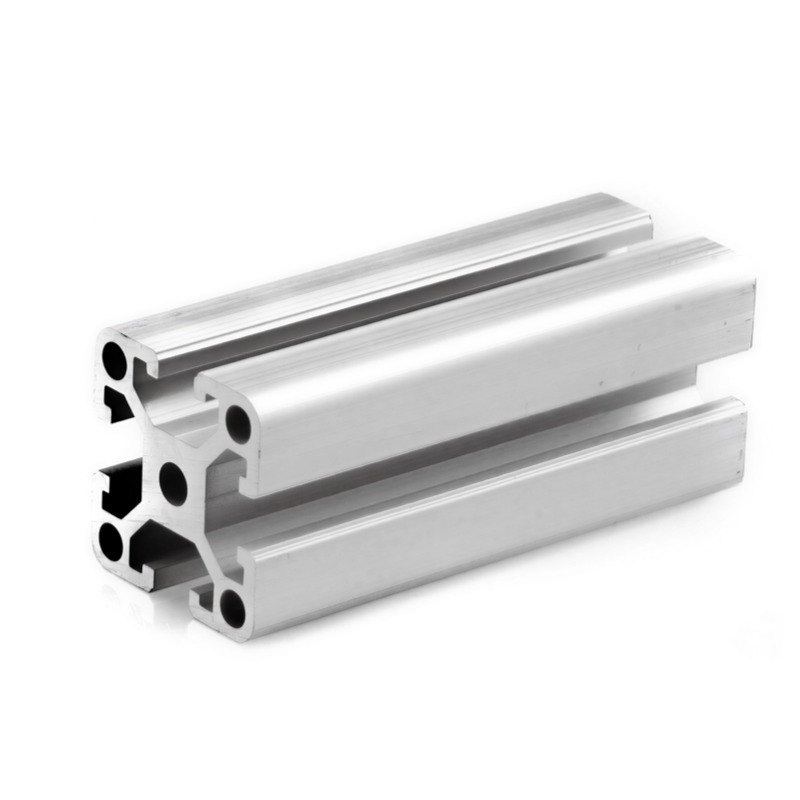
Industrial aluminum profiles
Perfil de aluminio con ranura en T 8-4040 - 40 x 40 mm, ranura de 8 mm
Perfil 8-4040: 40x40 mm, ranura de 8 mm, 6063-T5, pared de 2,0 mm, 1,45 kg/m, I 8,52 cm4, flecha de 0,34 mm a 1 m con 10 kg. Según plano.
Detalles del producto
Respuesta breve: 8-4040 is the general-purpose 40 × 40 mm square profile in the 8-series: 8 mm slot, 6063-T5, 2.0 mm wall, 1.45 kg/m, moment of inertia 8.52 cm⁴. It is the default starting point for equipment frames because the fitting range is the widest and the machining experience is the deepest, not because it is the most efficient section per kilogram. Working reference: about 0.34 mm deflection at 1 m span with 10 kg at the centre. Section and tolerance are set by your drawing.
Para qué se utiliza
It is the frame of most industrial equipment built from aluminum profile: machine bases, guarding structures, workstations, conveyor supports, test rigs, robot cells, laboratory fixtures, display systems and cleanroom furniture.
Its place in the range is deliberately central. Below it, sections are light and cheap but flexible. Above it, sections are stiffer but heavier, more expensive and served by a narrower fitting range. In most projects the design starts at 4040 and moves up only where a specific span or a specific load demands it.
That starting habit is worth understanding rather than following blindly, because 4040 is a compromise and knowing which side of the compromise your project falls on is what makes the choice right.
Especificaciones
| Elemento | Valor | Nota |
|---|---|---|
| Sección | 40 × 40 mm square | Serie 8, ranura de 8 mm |
| Aleación y temple | 6063-T5 | Estándar para el rango |
| Espesor de pared | 2.0 mm | 2.5 mm available as 8-4040B |
| Peso | 1.45 kg/m | |
| Momento de inercia | 8.52 cm⁴ | Equal in both directions |
| Ancho de ranura | 8 mm | Takes 8-series fittings, M8 hardware |
| Deflection, 1 m span, 10 kg at centre | About 0.34 mm | Peso propio excluido |
| Rigidez por kg | About 5.9 cm⁴ per kg/m | See the note below |
How the numbers compare
Against 6-2020, the moment of inertia is 8.52 against 1.20 cm⁴, roughly seven times. Since deflection is inversely proportional to inertia, the same load over the same span gives about one seventh of the sag: 0.34 mm instead of 2.4 mm. That is the real step between the two sizes, and it is much bigger than the difference in price suggests.
The less obvious point is efficiency. Inertia grows with the fourth power of section size while weight grows with the square, so a larger square section carries more stiffness per kilogram. The ratio here is about 5.9 cm⁴ per kg/m; 6-2020 is about 2.4 and 10-9090A is about 14.7. This is geometry, not a property of the alloy, and it explains why very small sections are the least efficient choice when stiffness is what you need.
Dónde encaja esto
It fits when spans are under about 1.5 m, loads are moderate, the frame has to accept a wide range of fittings, and the design may need to change during the build.
Dónde no encaja: if a single beam has to span more than about 2 m with real load and no intermediate support, go to 8-4080, 8-6060 or 10-4590 and check the deflection. If a joint has to take dense drilling and repeated disassembly, 8-4040B exists for that specific reason. And if the frame is a visual product rather than industrial equipment, 4040 may read as too heavy.
Why this size became the default
The fitting ecosystem decides more projects than the section. Brackets, hinges, corner connectors, cable clamps, panel retainers, castors, levelling feet and handles are all made in depth for 8-series 40 mm. A design that starts elsewhere has to verify every accessory, and a missing bracket often forces a redesign that costs far more than the profile. That is why 4040 is the sensible default: it is the size where the odds are that the part you need already exists.
Its compromise is span. At 1 m with 10 kg the deflection is 0.34 mm, which is fine. At 2 m the same load gives about 2.7 mm, because the span enters cubed, and that is visible in a machine frame and felt by a moving axis. The number to remember is that doubling the span multiplies the sag by eight. A design that works at 1 m does not work at 2 m without changing section.
8-4040B is not a general upgrade. The reinforced version has 10.20 cm⁴ and 1.80 kg/m, so about 20 percent more stiffness for 24 percent more weight. If the problem is overall rigidity over a span, that is a poor trade. Its value is in joints that must keep a 40 mm square outline while taking dense drilling and repeated assembly, where the extra wall gives a thread somewhere to live. Using it to solve a span problem is the wrong direction, and it is a common one.
And the slot is a constraint on design freedom. An 8 mm slot takes M8 hardware and the associated brackets, which is the practical middle of the range. Going to a 10-series section buys a 10 mm slot, thicker brackets and heavier bolts, but it also means a different fitting system. On a project that is already designed in 8-series, that change ripples through every joint.
Qué enviar para una cotización
- The frame drawing or the cut list with quantities
- Span and load for the members that carry anything, so the section can be checked
- Machining: end taps, cross holes, milled pockets, mitre cuts
- Finish, and whether the slot faces stay anodized or need masking
Preguntas frecuentes
¿Qué tolerancia puede mantener?
Cut length and machined features are held to the tolerance on your drawing, with mitre and end cuts set so the joint closes without a gap. The value on your order is set by your drawing, and on a frame with many members we agree the cut length convention before cutting, because a stacked tolerance in a rectangular frame shows up as a racked assembly.
How much does 8-4040 deflect?
About 0.34 mm at 1 m span with 10 kg at the centre, excluding its own weight. At 2 m the same load gives about 2.7 mm, because deflection scales with the cube of the span. That is the check to run before committing to the section.
When should I use 8-4040B instead?
When the joint has to survive dense drilling and repeated assembly while keeping the 40 mm outline. It is only about 20 percent stiffer, so it is a poor choice for a rigidity problem over a span. For span, a larger section is the right move.
Can I use M8 bolts in the slot?
Yes, the 8 mm slot is built around M8 hardware with T-nuts or hammer nuts. Heavier bolts need the 10-series, which is a different fitting system.
Is 6063-T5 suitable for a machine base?
For a light machine, yes. For a heavy machine or one with a moving axis, the question is deflection and vibration rather than strength, and a larger section or a steel base may be the right answer. We will tell you when the frame drawing looks under-designed.
How is it finished?
Clear anodizing as standard, black anodizing where the frame is visible or has to match equipment. Anodizing also hardens the slot faces, which take handling damage during assembly.
Siguiente paso
Send the frame drawing or cut list with the spans and loads. We will cut, machine and finish to your drawing and flag any member that looks undersized before production.
Correo: linjunbing@truetrustlv.com | Llame o WhatsApp: +86 136 6644 0600
OBTENER UNA COTIZACIÓN
Una vez que haya enviado sus requisitos, nos pondremos en contacto con usted lo antes posible con respecto a su consulta de producto.:Perfil de aluminio con ranura en T 8-4040 - 40 x 40 mm, ranura de 8 mm