
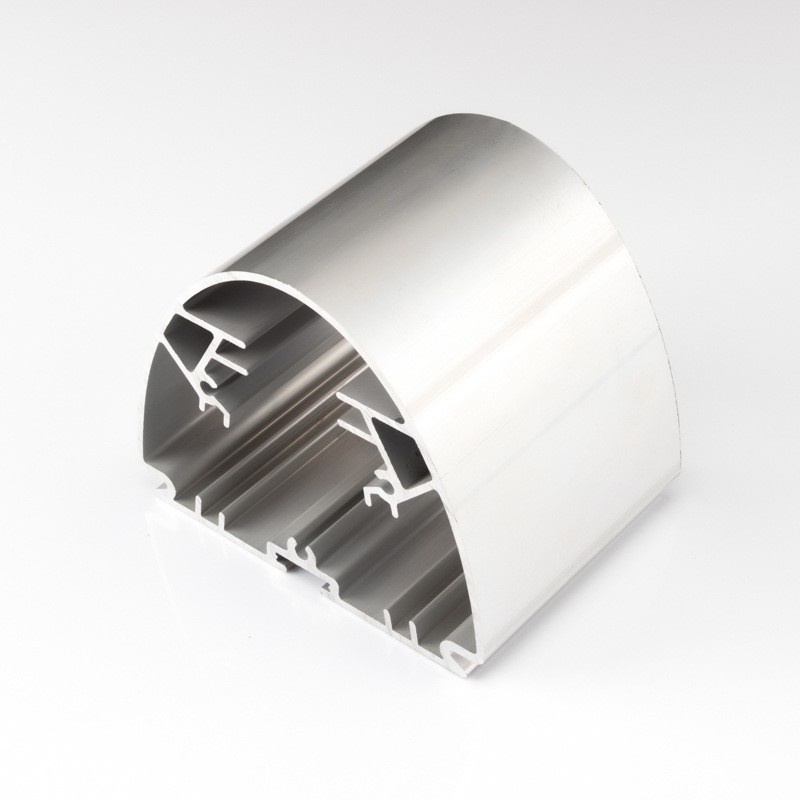
Custom Aluminum Profiles
Apertura de matriz de perfiles multicavidad - Secciones personalizadas
Secciones multicavidad con coaxialidad ≤0,03 mm y paredes desde 0,6 mm: simulación de flujo CAE, mapeo de líneas de soldadura, 6063/6061/7075.
Detalles del producto
A multi-cavity section looks like a good idea on a drawing: put two or three closed cavities into one profile, form the functions in, and save the assembly. It is a good idea, and it is also the hardest class of extrusion to get right, because every cavity needs its own mandrel, every mandrel needs support, and every support takes strength out of the die.
We open dies for sections with two or more independent cavities, down to 0.6 mm wall, with cavity coaxiality held to a reference 0.03 mm, in 6063-T5, 6061-T6 and 7075-T6. What follows is the tooling reality behind those numbers.
Every cavity costs you something
A single-cavity hollow section uses one mandrel, supported from one side. A three-cavity section uses three, and each one has to be held in position against the flow pressure of the metal going past it. There are only three ways to support a mandrel, and each has a price:
| Método de soporte | How it works | What it costs |
|---|---|---|
| Cantilever from the die core | Mandrel fixed at its root only | Deflects under load; limits cavity length and wall accuracy at the far end |
| Bridge support | A bridge of die steel crosses the cavity and holds the mandrel | Creates a weld line across the section at the bridge position |
| Porthole with welding chamber | Metal flows around the mandrel and re-joins behind it | Pressure loss; a seam weld for every cavity |
So a three-cavity section does not just have three times the tooling. It has three weld line sets, three pressure losses and a die that is significantly weaker than the same envelope with one cavity. The process window narrows accordingly, and the scrap rate rises before the part is even out of tolerance.
This is the trade to make explicitly at design review: does the function really need three cavities, or can it be two cavities with the third function machined, or an open section with a closure? A two-cavity version of the same envelope often runs at a materially lower cost with better wall control.
Cavity coaxiality: why 0.03 mm is the number that matters
For a multi-cavity part, the dimensions that usually matter are not the outside envelope. They are the relative positions of the cavities: the centre distance between two bores, the alignment of a through-cavity, the wall between two cavities.
Those positions are set by the die, and they are held by the die's steel, not by the press. Three effects move them:
Thermal growth of the die. A die at 480 °C is larger than the same die at 20 °C, and the growth is proportional to the dimension. It is predictable and it is compensated in the die cut, but only if the running temperature is known.
Elastic deflection under load. A multi-cavity die has less steel in it, so it deflects more. The deflection is not uniform: it is largest where the die is thinnest, which is between two adjacent cavities. The wall between cavities is therefore the thinnest part of the finished section.
Mandrel drift. Each unsupported mandrel tip moves a little in the direction of least resistance. Two mandrels on the same die can drift toward each other, closing the wall between them.
All three push in the same direction — the inter-cavity wall gets thin. That is why the tolerance on inter-cavity position is stated separately from the outside tolerance, and why a die for a multi-cavity part is corrected more times in trial than a single-cavity die.
CAE before the die is cut
On a straightforward section, a die can be designed from experience and corrected in trial. On a multi-cavity asymmetric section, that approach wastes billets: the flow imbalance is not obvious from the drawing, and the first trial shows which cavity starves and which one runs.
Flow simulation before cutting shows the velocity distribution across the die face and predicts which cavities fill first. That lets the bearing lengths be set correctly on the first cut. It does not eliminate trial correction — a simulation is a model, and the press is the reality — but it converts a two- or three-pass correction into one.
What the simulation is used for, specifically:
- Velocity balance between cavities, so neither starves.
- Predicting where the weld lines will land, so they can be moved to a non-visible or non-critical face.
- Checking whether a thin web between cavities will fill at all before committing to 0.6 mm.
- Estimating the pressure required, to confirm the section is inside the press window for the chosen alloy.
Weld lines: one per cavity, minimum
Every cavity formed by a porthole die creates at least one seam weld where the metal re-joins. A three-cavity section has at least three, and a section with bridge supports has more.
For an internal cavity, the seam is on the inside surface and is usually invisible. For an external feature formed by the same die, it can land on a visible face. That is why the weld line map has to be part of the die review, not a discovery at first article: once the die is cut, the seam can only be relocated by cutting a new die.
The other half of the problem is mechanical. A seam weld that is poorly bonded is a fatigue crack starter, and it is not visible from outside. On a part that sees vibration — robot arms, automation frames — that matters more than the appearance. It is checked by sectioning and bending a sample from the first lot, and it is the test we would ask for on any multi-cavity part with a cyclic load.
Especificaciones
| Elemento | Valor de referencia |
|---|---|
| Cavity count | Two or more independent cavities |
| Pared mínima | 0.6 mm |
| Cavity coaxiality | Reference ≤0.03 mm |
| External dimensional tolerance | Reference ±0.02 to ±0.04 mm |
| Joint face flatness | Reference ≤0.02 mm |
| Overall distortion | Reference ≤0.2 mm/m |
| Precisión de mecanizado CNC | Reference ±0.005 to ±0.01 mm |
| Aleaciones | 6063-T5 (≥205 MPa), 6061-T6 (≥310 MPa), 7075-T6 (≥524 MPa) |
| Círculo circunscrito máximo | 600–700 mm |
| Longitud máxima mecanizada | 6,500 mm |
| Estándar | GB/T 6892-2023 alta precisión |
| Plazo de matriz | 7–10 days for standard cross-sections, longer for asymmetric multi-cavity |
| Lote mínimo | 50 kg |
| Design support | CAE flow simulation before die cutting |
Section types and where each one breaks
| Tipo | Carácter estructural | Failure mode to watch |
|---|---|---|
| Multi-cavity integrated | Two or more cavities carrying different functions in one part | Inter-cavity wall thins under die deflection |
| Ultra-thin-wall multi-cavity | 0.6–1.8 mm walls with dense partitions | Partitions do not fill; mandrels drift and close the gap |
| Composite section | Bosses, deep grooves and shaped cavities combined | Flow imbalance between the bulky side and the thin side |
| Asymmetric cavity | Cavities differ in size or shape, so flow resistance differs | The smaller cavity starves or the larger one overfills |
Alloy choice: strength versus extrudability
The three alloys in this class sit on a line from easy to hard, and the harder ones make multi-cavity work much harder.
6063-T5 is the most extrudable: good flow, good surface, tolerates thin walls and multiple cavities better than anything else. Tensile strength from about 205 MPa. Default for structural multi-cavity parts that are not highly loaded, sensor housings, and communication equipment cavities.
6061-T6 gives about 310 MPa and machines well, but needs more pressure, so a multi-cavity design that works in 6063 may need thicker walls in 6061. Robot skeletons and automation frames where the load is real.
7075-T6 reaches about 524 MPa and is genuinely comparable to mild steel in strength, but its flow stress is high and its window is narrow. Multi-cavity 7075 is at the edge of what extrusion can do, and it is usually better to machine such a part from plate or to accept a 6082-T6 design with more section.
One thing worth saying plainly: if the reason for 7075 is stiffness, it will not help. Young's modulus is essentially the same for all of these alloys, around 70 GPa. Strength resists yielding; geometry resists deflection. A part that flexes too much needs more section, not a stronger alloy.
Dónde no encaja
- You need four or more independent cavities in a small envelope. The die has to hold all the mandrels and there is not enough steel left. It can be drawn; it cannot be run reliably.
- The cavities must be pressure-tight against each other. An extruded wall between two cavities is not a seal. If two media must not mix, use separate parts or machine a barrier.
- The inter-cavity wall is below about 0.8 mm. It is the thinnest region under die deflection and it is the first to fail. Widen it or reduce the cavity count.
- You need 7075-T6 at full width with thin walls. The flow stress is too high for the section. Step down to 6082-T6 or 6061-T6 and take the extra section.
- The volume is small. A multi-cavity die is the most expensive tooling in this class, with the most trial correction. Below a tonne or two a year it rarely pays back.
- Every cavity carries a different load and the design is still moving. Multi-cavity dies are the hardest to modify. Freeze all cavity positions before cutting.
- You need a visible anodised surface over a seam. The seam will show. Either accept a machined or painted finish, or relocate the seam in the die design.
Qué enviar para una cotización
Send the section drawing with every cavity dimensioned, the wall between cavities, the coaxiality requirement, the alloy and temper, the length, and the load case. Tell us which cavities carry what, because an asymmetric load case changes how the die should be balanced. If you have a thermal requirement, send it as well — a multi-cavity part is often used as a cooling or insulation structure, and that changes the alloy shortlist.
We will reply with a flow simulation summary, the weld line map, the cavity count we consider reliable for your envelope, the wall thicknesses that will fill, and a written statement of the tolerances we can confirm. If a cavity or a wall cannot be produced, that goes in the reply rather than in the first article report.
Preguntas frecuentes
What counts as a multi-cavity section?
Two or more independent closed cavities in one profile, where each cavity needs its own mandrel. A single hollow box is one cavity; a section with a box plus a separate internal channel is two. The tooling difficulty steps up at every additional cavity, which is why the count is worth discussing before the shape.
What is the minimum wall you can produce?
Reference 0.6 mm, and it is realistic on 6063-T5 in a section that is not too wide or too complex. On 6061-T6, or on a section with several cavities, 0.8–1.0 mm is the honest figure. The value on your order is set by your drawing, and we confirm in writing what we can hold — including saying when a wall will not fill reliably.
How is cavity coaxiality held?
By die design and die correction. The cavity positions are cut into the die steel, and the die is corrected in trial until the wall between cavities and the centre distances are in tolerance. Reference ≤0.03 mm is achievable on a well-balanced section; on a strongly asymmetric one it is harder, and we will say so before quotation rather than after.
What does CAE simulation actually buy me?
Fewer trial passes. On an asymmetric multi-cavity section, the flow imbalance is not obvious from the drawing, and without simulation the die is corrected by trial and error. With simulation, the bearing lengths are set correctly on the first cut, which typically removes one or two correction passes. It shortens the lead time and reduces the trial material consumed.
Can you do 7075 in a multi-cavity section?
Sometimes, and rarely at full size. 7075 has high flow stress, so the pressure required rises with cavity count and wall thinness, and the window narrows quickly. If you need high strength in a complex section, 6082-T6 or 6061-T6 with more section is usually the better engineering answer. If you need 7075 properties specifically, a machined part is the reliable route.
¿Cuál es el plazo de entrega?
Reference 7–10 days to sample for a standard cross-section, longer for an asymmetric multi-cavity design because the trial correction takes more passes. Plan for at least one correction cycle on anything with three or more cavities. We will quote the realistic date rather than the optimistic one.
¿Cuál es el lote mínimo?
Reference 50 kg. A multi-cavity die is expensive, so the cost per kilo at 50 kg is high; the economics improve steeply with volume. If you are at prototype stage, tell us — a machined or open-section version may be the cheaper way to prove the design before committing to a die.
Envíe su plano
Email the section drawing with all cavities dimensioned, the coaxiality requirement, the alloy and the load case to linjunbing@truetrustlv.com, or send it on WhatsApp at +86 136 6644 0600. You will get a flow simulation summary, a weld line map and a written tolerance statement before the die is cut.
OBTENER UNA COTIZACIÓN
Una vez que haya enviado sus requisitos, nos pondremos en contacto con usted lo antes posible con respecto a su consulta de producto.:Apertura de matriz de perfiles multicavidad - Secciones personalizadas