
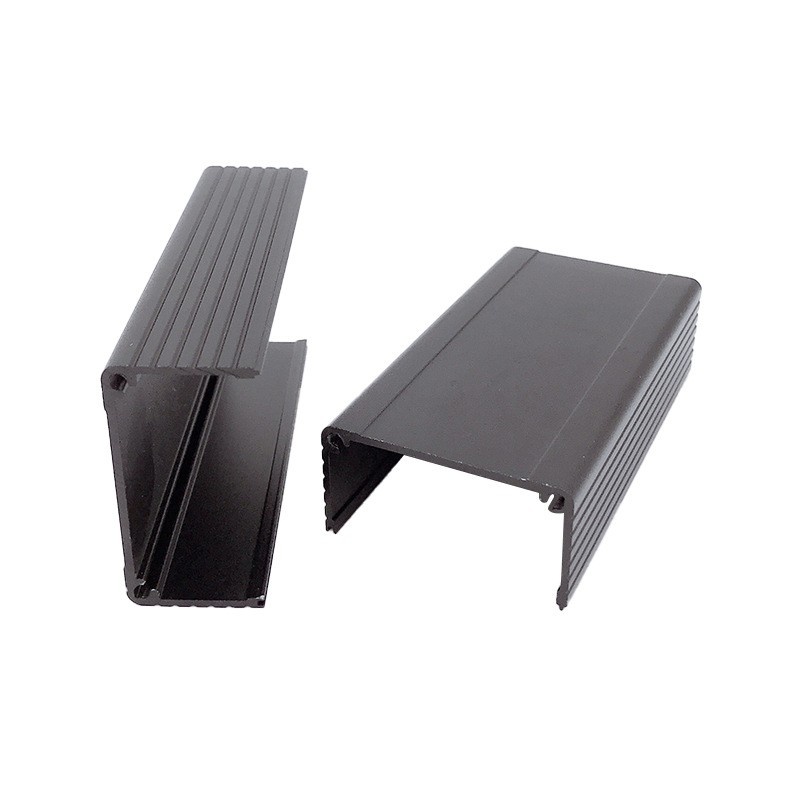
Custom Aluminum Profiles
Aircraft Grade Aluminum Profiles - 7075, 2024, 7050
Aircraft grade aluminum sections in 7075-T6, 2024-T351 and 7050-T7451: lot traceability, ±0.02-0.03 mm, ultrasonic and penetrant inspection.
Detalles del producto
Respuesta breve: an aircraft-grade profile is not defined by its alloy — it is defined by what can be proved about it. Same 7075-T6, two suppliers, and only one of them can produce a mill certificate that matches the heat-treat lot, mechanical test results from that lot, and an inspection record that survives an audit. We extrude 7075-T6, 2024, 7050 and 6061-T6 up to a 700 mm circumscribed circle at ±0.02–0.03 mm on critical positions, with ultrasonic and penetrant inspection available. What we do not do is claim an aerospace accreditation we do not hold, and we will say that plainly.
The alloy is the easy part
Anyone can write 7075-T6 on a drawing. What makes a profile usable on an aircraft programme is the chain of evidence behind it: the billet's chemistry, the heat-treat lot, the mechanical properties measured on that lot rather than on a generic table, the dimensional record, and the non-destructive inspection that proves the part is sound inside. A supplier who cannot trace a delivered length back to a lot and a test report is not an aerospace supplier, whatever alloy they extrude.
That is worth stating because the market is full of "aviation grade" claims attached to ordinary industrial extrusion. The alloy may genuinely be 7075. The evidence chain is what is missing.
Where each alloy actually sits on an airframe
The choice is driven by the load type at that location, not by which alloy is strongest.
| Aleación | Resistencia | Where it belongs | Why there |
|---|---|---|---|
| 7075-T6 | Tensile ≥ 524 MPa, yield ≥ 455 MPa | Wing upper surface, compression-critical structure, fittings, landing gear components | Highest strength in compression-dominated structure where fatigue crack growth is not the governing case |
| 7075-T73 | About 10% lower yield than T6 | Anything under sustained tension in a corrosive environment | Much better resistance to stress-corrosion cracking; the temper, not the alloy, is the fix |
| 2024-T351 | Tensile ≥ 420 MPa, yield ≥ 265 MPa | Fuselage skin, wing lower surface, fatigue-critical structure | Superior fatigue crack growth resistance; usually clad for corrosion protection |
| 7050-T7451 | Tensile ≥ 510 MPa | Thick-section structural extrusions, wing spars | Strength and stress-corrosion resistance together in thick section, where 7075 cannot be quenched adequately |
| 6061-T6 | Tensile ≥ 290 MPa | UAV frames, general-aviation structure, brackets, non-primary parts | Weldable, corrosion resistant, cheap, and adequate where strength is not the binding case |
Notice the pattern: the highest-strength alloy is not the default. A wing lower surface, which sees tension and fatigue, is 2024 territory. A wing upper surface, which sees compression and buckling, is 7075 territory. A fuselage skin is 2024 for crack growth. Choosing 7075 for everything is a signature of a design that has not been load-pathed.
Especificaciones
| Elemento | Rango y nota |
|---|---|
| Aleaciones | 7075-T6 / T73, 2024-T351, 7050-T7451, 6061-T6 |
| Círculo circunscrito | Hasta 700 mm |
| Tolerancia de posición clave | ±0.02–0.03 mm |
| Tolerancia de sección | ±0.02–0.04 mm on critical dimensions |
| Tolerancia mecanizada | ±0.01 mm typical, ±0.005 mm on a five-axis centre |
| Longitud máxima | 6,500 mm machined |
| Presses | 600–12,000 t including partner lines for heavy sections |
| Superficie | Anodising, hard anodising, chromate conversion, conductive anodising, primer systems |
| Inspección | CMM dimensional report, ultrasonic, liquid penetrant, hardness and conductivity |
| Material documentation | Mill certificate with chemistry and mechanical properties, traceable to heat-treat lot |
| Norma de referencia | GB/T 6892-2023 ultra-high-precision grade; documentation can be prepared to support GJB and AMS flow-down |
| Cantidad de prueba | Desde 50 kg para una construcción de desarrollo |
What "aviation grade" should mean on a purchase order
Four things, and a supplier should be able to answer all four without a meeting.
Chemistry and lot traceability. The billet composition and the heat-treat lot, marked on the part or on the package, traceable to the certificate. Without this, a mechanical test result proves nothing about the parts you received.
Mechanical properties measured, not quoted. Tensile and yield from the lot, not from a handbook. A handbook number is a minimum for the alloy, not a statement about your extrusion.
Non-destructive inspection appropriate to the part. Ultrasonic for internal soundness — inclusions, centre-line segregation, quench cracks. Liquid penetrant for surface-breaking defects at fillets and section changes. On a load-bearing 7xxx part, a dimensional report alone is not inspection.
Process records. Extrusion temperature, quench, ageing cycle, straightening method. On a hard alloy these are what determine whether the properties are real, and they are the first thing an auditor asks for.
What a component supplier cannot give you is a design approval. Airworthiness sits with the type certificate holder; a supplier provides conforming parts and the evidence that they conform. Any supplier who implies otherwise is worth a second look.
Section design for these alloys
Aircraft sections are usually thin-walled and stiffened, which is the opposite of what extrudes easily in a hard alloy. Three compromises recur.
Integral stiffeners beat separate ones, because they remove fasteners and the fatigue they bring — but a thin integral blade in 7075 is a die risk. The usual answer is a thicker blade with a draft, or a change to 7050 which flows better in thick sections.
Sharp corners are not allowed. Notch sensitivity in a low-elongation alloy turns a sharp internal corner into a crack starter, and the same corner cracks the die. Every internal corner gets a radius.
Machining allowance has to be built in. A quenched and straightened hard-alloy section will not be straight to the tolerance the drawing asks for. One to two millimetres on the faces that will be machined, and a sequence of rough, stress-relieve, finish.
Dónde no encaja
- Any part that will be welded. 2xxx and 7xxx are not production-weldable; the strength advantage disappears at the joint even where a laboratory process exists.
- Any requirement for a bright uniform anodised finish. Copper-bearing alloys produce a dark, patchy film.
- Service above roughly 120–150 °C, where the temper overages and the properties on the certificate no longer describe the part.
- Marine or wash-down duty without a coating system, particularly for 2024, which will pit.
- Programmes that require a design approval, a PMA or a type-certificate-level release. That is not a component supply activity.
- Cost-driven structure where strength is not the binding requirement — 6061-T6 or 6082-T6 will carry most of those cases.
Qué enviar para una cotización
- The part drawing with the alloy, temper and extrusion direction marked
- The load case and the failure mode that governs — strength, fatigue, buckling or stiffness
- The specification the part must conform to, and the documentation package you need with it
- The inspection requirements: ultrasonic, penetrant, hardness, conductivity, dimensional
- The surface treatment and any area that must stay conductive for bonding or grounding
- Any heat in the downstream process — welding, brazing, cure cycles — because it resets the temper
- The quantities and the lot structure you need, since lot traceability has to be planned into the run
- The faces that will be machined, so allowance and stress relief can be sequenced
Preguntas frecuentes
What makes a profile aerospace grade rather than industrial grade?
The evidence chain, not the alloy. The same 7075-T6 can be supplied as an industrial extrusion with a chemistry certificate and nothing else, or with lot traceability, mechanical properties measured on that lot, ultrasonic and penetrant inspection, and process records for the quench and ageing. The second is what an aerospace programme needs. Ask for the documents before you ask for the price.
Can you supply to GJB or AMS requirements?
We can prepare material and process documentation to support your flow-down, and we will state exactly what we can and cannot provide before you order. What we do not claim is an accreditation we do not hold. Being clear about that boundary is more useful than a certificate that will not survive an audit.
Which alloy for a wing or a fuselage part?
Follow the load: compression-dominated upper-wing structure is 7075 territory, tension and fatigue-critical lower-wing and fuselage skin is 2024, thick-section spars are 7050-T7451, and non-primary structure and UAV frames are 6061-T6. Choosing 7075 everywhere is a sign that the load path has not been worked out, and it usually costs fatigue life.
What inspection do these parts need?
Ultrasonic for internal discontinuities, liquid penetrant for surface-breaking cracks at fillets and section changes, and hardness or conductivity as evidence of temper. Dimensional inspection proves the shape and says nothing about whether a quench crack is present. On any load-bearing 7xxx or 2xxx part, specify all three and say which standard you are inspecting to.
¿Qué tolerancia puede mantener?
Reference ±0.02–0.03 mm on critical assembly positions and ±0.01 mm on machined features, with ±0.005 mm available on a five-axis centre. The value on your order is set by your drawing, and we confirm it before tooling. On these alloys the limiting factor is part stability rather than machine capability, so the quench, straighten, stress-relieve and machine sequence is part of the tolerance agreement.
Why is 7050 used instead of 7075 in thick sections?
Because 7075 cannot be quenched fast enough at the core of a thick section, so its properties fall off through the thickness and its stress-corrosion resistance in the short-transverse direction becomes marginal. 7050 was developed for exactly that problem and is supplied in T7451 to give strength and corrosion resistance together. If the section is thin, 7075 is fine and cheaper.
Envíe su plano
Email linjunbing@truetrustlv.com with the part drawing, the alloy and the specification you must conform to. Tell us what documentation package your programme needs and we will answer honestly about which parts of it we can produce. You will get a feasibility note, an inspection and documentation plan, and a price — reviewed by an engineer.
WhatsApp: +86 136 6644 0600
OBTENER UNA COTIZACIÓN
Una vez que haya enviado sus requisitos, nos pondremos en contacto con usted lo antes posible con respecto a su consulta de producto.:Aircraft Grade Aluminum Profiles - 7075, 2024, 7050