
Automated logistics
Stacker Crane Floor Rails - Base, Anchors and Levelling
A 1.5 mm/10 m rail cannot be laid on a floor finished to 5 mm. Anchor pitch, grout shrinkage, slab movement, and why the rack is the datum.
Detalles del producto
A stacker rail is specified to 1.5 mm over 10 m, and then it is bolted to a concrete floor that was finished to plus or minus 5 mm over 2 m. That gap is the whole engineering problem. The rail is not the hard part; getting a floor to accept a rail at that accuracy, and keeping it there, is.
The main stereoscopic warehouse rail page covers parallelism between the two rails. This page is about what happens underneath a single rail — the base, the anchors, the grout — because that is where most on-site accuracy is lost and where most of the drift in the first two years comes from.
The rail is a bridge between anchors, not a line on the floor
A rail on a concrete floor does not sit on the floor. It sits on the anchor points and on whatever packing was used between them. Between two anchors the rail spans, and under a wheel load it deflects. The deflection is small — a few hundredths of a millimetre over a 600 mm anchor pitch — but it is not zero, and it matters because the stacker's positioning accuracy is quoted against the rail's theoretical line, not its loaded line.
More importantly, the rail adopts the shape of its supports. If the floor has a 3 mm hollow between two anchors, the rail either follows it or is pulled straight by the anchors and left with a locked-in bending stress. Neither is good: the first loses accuracy, the second means the rail is preloaded before it carries anything.
Especificaciones
| Elemento | Valor de referencia | Notas |
|---|---|---|
| Aleación y temple | 6061-T6, yield ≥ 240 MPa | Chosen for wheel pressure on the running flange |
| Stacker class | 500–1000 kg | System weight, not single-wheel load |
| Rectitud | Reference ≤ 1.5 mm over 10 m | Measured on the running face after machining |
| Dual-rail parallelism | Reference ≤ ±0.8 mm over 10 m | Set at installation, not only at manufacture |
| Tolerancia mecanizada | Reference ±0.02 to ±0.04 mm | On mounting faces, slot widths and joint interfaces |
| Travel positioning | Reference ≤ ±2 mm | System figure; depends on drive and encoder as well |
| Surface at running face | Hard anodised | Wear resistance in high-cycle aisles |
| Weight versus steel | About one third | Reduces floor load and drive force |
All figures above are reference values from shipped projects. The value on your order is set by your drawing, and we confirm the achievable straightness, parallelism and machined tolerance in writing before you place the order.
Why a flat floor does not give you a straight rail
Floor flatness and rail straightness are measured differently and are not interchangeable. A floor is usually specified as flatness within a few millimetres over a two-metre straightedge. A rail is specified as deviation from a line over ten metres, which is a different kind of measurement and a much tighter one.
The consequence is that a rail laid directly on a finished floor will follow the floor's undulations and inherit them. A hollow of 3 mm across 2 m becomes a 3 mm deviation in the rail, which is double the allowance over the same length. And because the deviation is smooth and gradual, it does not show up in a short check — it shows up when the stacker is at the far end of the aisle and the fork misses the pallet opening by a few millimetres.
There are two ways to deal with it. The first is a levelling layer: adjustable shims or levelling nuts under the rail, set against a laser or a wire, then locked. The second is a grout bed, where the rail is set on temporary supports to the correct line and grout is poured underneath to fill the gap permanently. Shimming is faster and reversible; grouting is more stable over time and better where the floor will see traffic or washdown.
Anchor pitch is a stiffness decision
The anchor pitch sets the span between supports, and the rail's behaviour between them follows the same rule as any beam: deflection falls with the cube of the span for a point load. Halving the pitch does not halve the deflection, it cuts it by roughly eight.
For a stacker rail the practical range is 500 to 800 mm. Below 500 the anchors start to crowd the section and interfere with the mounting slots; above 800 the rail becomes visibly compliant under a loaded wheel and the anodised running face starts to show a repeating wear pattern at the anchor positions.
Two details matter more than the pitch itself. First, the anchor must not clamp the rail so hard that it distorts the running flange — a through-bolt tightened against a thin flange will pull a local dip into the running surface, and that dip is exactly where the wheel will pound. Second, the holes in the rail should be slotted across the rail axis, not along it, so that thermal movement is taken out of the slot rather than out of the anchor.
What the installation looks like a year later
Almost every accuracy complaint on a stacker rail arrives months after commissioning, not on the first day. The causes are consistent:
- Grout shrinkage. A cementitious grout shrinks as it cures. If the rail was set to line on wet grout and never re-checked, the line drops by a fraction of a millimetre as the bed settles, and it does so unevenly along the length.
- Anchor relaxation. Concrete creeps under sustained load. Anchors that were torqued to specification lose preload over the first year, and the rail begins to move between them.
- Floor slab movement. A warehouse floor is a slab on grade, and slabs move. Joints open, edges curl, and a rail that crosses a slab joint will follow it.
- Thermal movement against a fixed end. A 20 m aluminium rail moves about 5.6 mm over a 10 °C swing. If both ends are hard-fixed, that movement has to go somewhere, and it goes into a slight bow.
The countermeasures are cheap if they are designed in: a non-shrink grout, a re-torque visit at six months, a rail that crosses slab joints on a continuous support rather than spanning the joint, and one end of each rail run left free to slide in a slotted connection.
The rack and the rail have to settle together
In a stereoscopic warehouse the rail and the racking stand on the same slab, and they are loaded very differently. The rack carries tonnes on a few legs; the rail carries a moving point load on a continuous line. If the slab settles under the rack legs and not under the rail, the relationship between the rail line and the rack face changes, and the fork that was aligned at commissioning is no longer aligned.
This is why the rail survey should be tied to the rack, not to the building. The reference line for the rail should be set from the rack uprights at both ends of the aisle, and the rail should be surveyed again after the rack is loaded. A rail that is straight relative to the building but 6 mm off relative to the rack is still a rail that misses.
Why aluminium and not steel here
On a floor rail the argument for aluminium is not only weight. A steel rail in a warehouse aisle rusts wherever the paint is damaged, and the running face is exactly where paint gets damaged. Rust on the running face becomes a lapping compound under the wheel, and the wear accelerates.
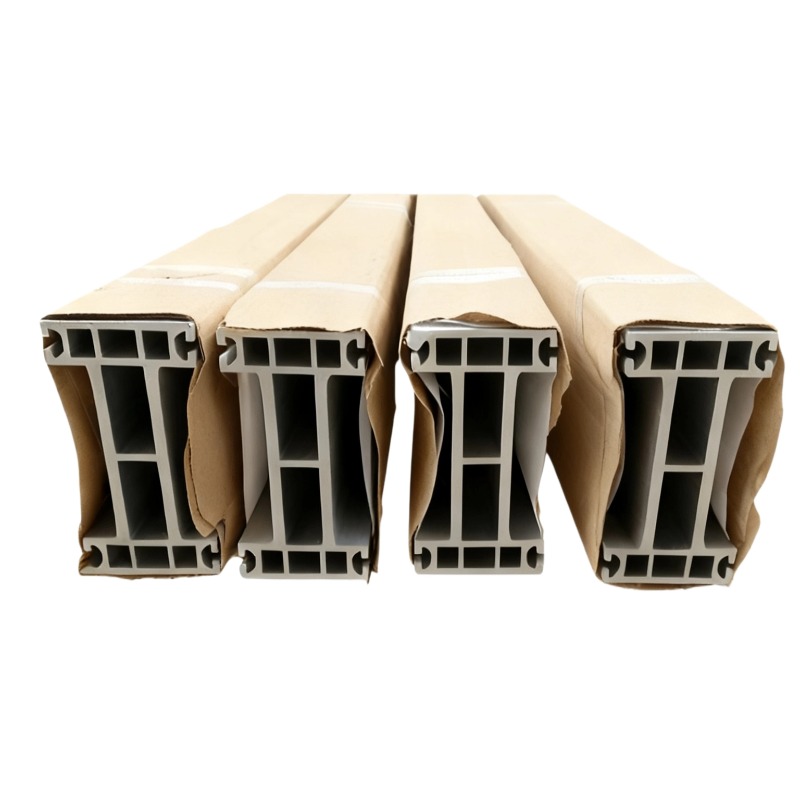
Aluminium does not rust. Anodising gives a hard, dimensionally stable running surface with no coating to chip off, and the section can carry the mounting slots, the guide grooves and the sensor card slot in one extrusion rather than being fabricated from several pieces. The lower weight also reduces the force the drive has to accelerate and stop, which on a tall stacker matters for both energy and positioning stability.
Dónde no encaja
There are four cases where we would tell a customer not to use this rail. If the aisle is longer than about 60 m, the thermal movement and the accumulated straightness error make a continuous aluminium rail difficult to hold, and segmented steel with expansion joints is the better answer. If the stacker is above roughly two tonnes, wheel pressure on the flange exceeds what 6061-T6 will take in the long term and a hardened steel running strip becomes necessary. If the floor is a suspended slab rather than on grade, the deflection of the slab under a moving load dominates everything the rail does, and the slab has to be assessed first. And if the site cannot guarantee a clean, dry aisle, the anchor pockets will collect water and the fixings will fail from the bottom up regardless of the rail.
Qué enviar para una cotización
- The aisle length and the anchor pitch you intend to use, or the floor drawing with the slab joints marked.
- The stacker weight, wheel load and the number of wheels per rail.
- The required positioning accuracy and the reference you measure it against — rack face, building line or laser.
- Whether the rail will be grouted or shimmed, and whether the ends are to be fixed or free to slide.
If the floor is already poured, send the survey. We would rather adjust the rail design to a floor we know about than supply a rail that meets a specification on paper and cannot be installed to it.
Preguntas frecuentes
What straightness and parallelism can you hold?
Reference 1.5 mm over 10 m straightness on a single rail, and ±0.8 mm over 10 m between the two rails. Those are machined and assembled figures; the installation adds to them, which is why we ask for the anchor pitch and the floor condition. The value on your order is set by your drawing, and we confirm the achievable straightness and parallelism in writing before you order.
Can the rail be installed straight onto an epoxy floor?
Only with a levelling layer. Epoxy is a coating, not a structural bed — it will creep under a point load and it will not hold an anchor preload. The anchor has to reach the concrete below, and the rail has to be levelled on shims or grout above the coating.
Do I need expansion joints in the rail?
For a run under about 30 m, one free end is usually enough. Above that, we would design a joint with a machined sliding connection, because the cumulative movement becomes large enough to matter at the running face. A 60 m rail moves about 17 mm over a 10 °C swing.
How often should the rail be re-surveyed?
Once after the rack is loaded, and once at about six months when the anchors have taken their set. After that, annual checks are enough unless the aisle sees heavy traffic or washdown.
Will hard anodising hold up under a stacker?
Yes, provided the wheel is not harder than the coating and the surface is not contaminated. Hard anodising gives a coating in the 25–50 µm range with a hardness well above the substrate. The failure mode to watch is chipping at the rail ends and at anchor holes, where the coating is unsupported, which is why those areas are masked during finishing.
Can you supply the rail in segments for a long aisle?
Yes, and for long aisles we recommend it. Segments of 6 to 8 m are easier to transport, easier to install to line, and let the joints be positioned away from the highest-traffic part of the aisle. Each joint needs a hanger or anchor beside it and a machined step below 0.1 mm.
Siguiente paso
Send the aisle drawing with the slab joints and the stacker wheel loads. We will come back with a section, an anchor pitch and a joint layout, and we will tell you which parts of the floor need to be levelled before a rail can be set to line.
Correo: linjunbing@truetrustlv.com | Llame o WhatsApp: +86 136 6644 0600
OBTENER UNA COTIZACIÓN
Una vez que haya enviado sus requisitos, nos pondremos en contacto con usted lo antes posible con respecto a su consulta de producto.:Stacker Crane Floor Rails - Base, Anchors and Levelling