Aluminum product surface
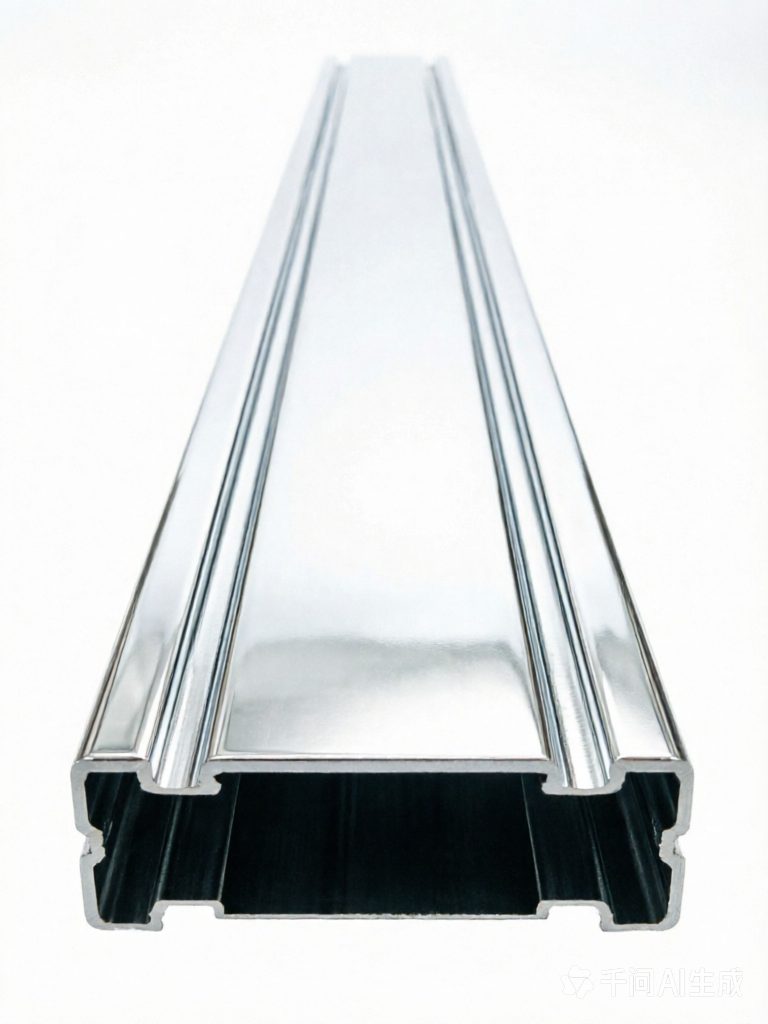
Perfiles de aluminio pulido espejo
Perfiles de aluminio pulido espejo con Ra 0,1 µm y 90% de brillo, sellados bajo anodizado transparente o e-coat transparente. Rugosidad y protección acordadas según plano.
Detalles del producto
Respuesta breve: polishing brings an extruded profile to a mirror surface at Ra ≤ 0.1 µm and gloss ≥ 90%, close to stainless steel. It is done by mechanical, chemical or electrolytic means, or a combination, depending on the shape. The part that gets skipped is the protection: freshly polished aluminum is chemically active and loses its gloss on its own within weeks, so a mirror finish is only delivered as a system, polished and then sealed under clear anodizing or clear e-coat. We confirm the roughness, the gloss and the protection layer against your drawing before production.
Why a mirror finish is never sold bare
Polished aluminum looks like a finished product the moment it leaves the wheel, which is exactly why the mistake gets made. Bare of any barrier, the surface reacts with air and moisture immediately, and the mirror dulls to a flat white haze. On a part in a dry indoor enclosure that might take months. On anything shipped by sea, it can happen before the crate is opened, because airborne chloride accelerates it sharply.
So the process is really two steps, and only the second one makes the first one last. After polishing, the surface is either clear-anodized, which grows a transparent oxide film that follows the polished topography, or clear e-coated, which lays a 15–35 µm transparent film over it. Both keep the reflection. The difference is what they add:
- Clear anodizing adds abrasion resistance and a harder surface, which matters if the part will be handled. It also adds a very slight tint and a small dimensional change, because the film grows from the metal.
- Clear e-coat adds a denser barrier and slightly deeper gloss, with better corrosion performance, and it coats recesses and edges evenly. It is a polymer film rather than a conversion layer, so it is softer than anodizing.
The practical rule: if the part is decorative and will be touched, anodize after polishing. If it needs maximum corrosion resistance or has recessed detail, e-coat. If it needs both, polish, anodize, then e-coat.
Especificaciones
| Elemento | Rango |
|---|---|
| Proceso | Mechanical polishing, chemical polishing, electrolytic polishing, used singly or in combination |
| Rugosidad superficial | Reference Ra ≤ 0.1 µm on the polished face |
| Brillo | Reference ≥ 90% at 60° |
| Surface condition | No scratches, no pinholes on the finished face |
| Protección | Clear anodizing or clear electrophoretic coating, applied after polishing |
| Aleaciones | 6063-T5, 6061-T6, high-purity 6-series for the brightest result |
| Longitud máxima de pieza | 6,500 mm |
| Inspección | Roughness and gloss reported per batch; visual check for scratches and pinholes |
Three ways to polish, and when each one is right
The three processes cut the surface differently, and choosing the wrong one either costs money or leaves the part short of the target.
- Mechanical polishing. Abrasive wheels and belts micro-cut the surface in stages, coarse to fine. It is the workhorse: it removes the extrusion marks first, then refines what is left. It struggles where a wheel cannot reach, which means inside returns, narrow slots and complex contours.
- Chemical polishing. The part is immersed in a polishing bath, and the solution dissolves micro-peaks faster than micro-valleys, so the surface levels itself. Because it works by immersion rather than contact, it reaches shapes a wheel cannot, and it does many parts at once. It is the step that turns a mechanically polished surface into a mirror.
- Electrolytic polishing. Anodic dissolution in an electrolyte, controlled by current rather than by abrasives. It produces the highest finish and a bright, slightly bluish depth, and it leaves no abrasive residue. It is the slowest and the most sensitive to alloy, which is why it tends to be used as a final pass rather than the whole process.
In practice a mirror part is mechanical first, to remove the profile's own surface, then chemical or electrolytic to level what remains. Which of the last two is used depends on the geometry: deep recesses push toward chemical, flat faces and the brightest target push toward electrolytic.
What the numbers actually mean
Ra 0.1 µm and gloss 90% are both real specifications, but neither is a photograph. Ra is an average roughness measured in one direction, so a surface can hit Ra 0.1 in the drawing direction and read differently at 90°, which matters on a part with visible orientation. Gloss at 60° is a reflectance measurement, and two parts at the same gloss can look different if one has a waviness the other does not, because a mirror shows distortion rather than texture.
That last point is the one buyers underestimate. A mirror surface acts as an optical element: any waviness in the extrusion underneath, any slight bend along the length, becomes visible as distortion in the reflected image. A part that measures perfectly on roughness and gloss can still be rejected on a reflective face because the extrusion was not flat to begin with. If the reflection has to be optically clean, the flatness of the base profile is part of the specification, not just the polish.
Dónde encaja esto
- Decorative trim and visible architectural profiles where the metallic reflection is the product
- Appliance and consumer product fascias that need a stainless-steel look without the weight
- Lighting reflectors and louver surfaces where high reflectance is functional
- Display fixtures and retail hardware where a bright finish carries the perceived quality
- Parts that would otherwise be made in stainless and can be redesigned in aluminum
Dónde no encaja
- Any part handled roughly or transported unprotected. A mirror finish cannot be repaired locally; a scratch means re-polishing the whole face, and a dent cannot be fixed at all.
- Surfaces exposed to abrasive dust, grit or washdown. The finish degrades visibly and permanently.
- Hidden or internal parts, where the cost buys nothing.
- Parts that will be welded or bent afterwards, since both destroy the polished face at the joint.
- Outdoor architectural use without a specified protection layer, where oxidation will dull it within a season.
Where a mirror is wanted but the exposure is harsh, the honest answer is usually a bright anodized or brushed finish rather than a true mirror: it keeps most of the appearance and survives contact.
Qué enviar para una cotización
- The drawing, with the faces that must be mirror-polished marked, since the cost is per face
- The alloy, because high-purity 6-series polishes brighter and more uniformly
- The target roughness and gloss, or the application if the numbers are still open
- Which protection layer you want: clear anodize, clear e-coat, or both
- Whether the part will be handled, packed individually, or shipped loose
- Cantidad y la longitud individual más larga, verificada contra el límite de 6.500 mm
If you have a sample of an existing part whose finish you want to match, send it. Matching to a physical sample removes the ambiguity that numbers alone leave.
Preguntas frecuentes
What roughness and gloss can you hold?
As a reference, Ra ≤ 0.1 µm and gloss ≥ 90% at 60° on the polished face. Those are achievable on flat 6063 and 6061 faces with the full mechanical-plus-electrolytic sequence. Complex geometry, deep recesses and lower-purity alloys move the numbers, and the flatness of the base extrusion can limit the result regardless of the polish. We confirm the achievable values for your part against the drawing before production.
Does the mirror finish need a protective layer?
Yes, always. Polished aluminum oxidizes on its own and dulls within weeks, faster in humid or coastal air. Clear anodizing or clear e-coat is what makes the finish survive. A supplier quoting a mirror polish without a protection step is quoting something that will look different on arrival than it did at the factory.
Can a scratch be repaired?
Not locally. A mirror surface has to be re-polished across the whole face, because a spot repair leaves a visible transition. On an anodized or e-coated part the coating has to be stripped first. This is why packing matters: individually wrapped with a protective film, not loose in a crate with other profiles.
Will polishing change my dimensions?
Only by a few microns on the polished faces, since the process removes material rather than adding it. That is negligible for a decorative part and not negligible for a precision fit, so tell us which dimensions are critical and they are left unpolished or compensated for.
Which alloy gives the best mirror?
High-purity 6063 and 6061. Impurities and alloying elements scatter light at the polished surface, so a lower-purity alloy polishes to a slightly hazy reflection rather than a true mirror. If the brightest possible result is the goal, the alloy has to be chosen before the profile is extruded, not after.
Can you polish a profile that is already anodized?
No, the coating has to be removed first, which means stripping and re-anodizing. It is normally cheaper to start from an uncoated extrusion, so if a batch needs a mirror finish, the anodizing should be sequenced after the polishing rather than before.
Envíe su plano
Email linjunbing@truetrustlv.com with the drawing, the faces to be polished and the protection layer you need. If you have a sample whose finish you want to match, send that too. You will get a process proposal, a quotation and the roughness we can hold — reviewed by an engineer, not an auto-reply.
WhatsApp: +86 136 6644 0600
OBTENER UNA COTIZACIÓN
Una vez que haya enviado sus requisitos, nos pondremos en contacto con usted lo antes posible con respecto a su consulta de producto.:Perfiles de aluminio pulido espejo